
Most RV solar buying guides point you at panels and kits, then treat the charge controller as a footnote. That is backwards for anyone actually living off the grid, because the controller is the piece that decides whether your panels actually charge your battery safely, and whether that battery is a lead-acid bank or a 200Ah LiFePO4 brick. If you have ever wondered why your lithium battery sits at half charge while the panels are in full sun, the answer is almost always the controller.
That is why this guide looks only at the best rv solar charge controllers for boondocking. We compared eight standalone controllers that RVers actually install, side by side, on tracking efficiency, battery chemistry support, monitoring options, physical footprint and the honest limitations of each. No kits, no bundles, no filler. Every pick here is a controller you can bolt into a bay and wire between your panels and your house bank.
A solar charge controller sits between the panel array and the battery. It watches battery voltage and current, throttles incoming power as the battery fills through bulk, absorption and float stages, and blocks current from flowing backwards into the panels after sunset. Without one, your battery overcharges and slowly drains itself every night through the panels.
Boondocking also changes the math compared to a parked rig. Your panels fight shade from roof vents, a generator running nearby, and a fanless controller cooking in a hot compartment. We still think a generator is a worthwhile backup for long stretches of bad weather, and we rank those in our RV generator roundup, but solar is what keeps you off the throttle day after day.
Table of Contents
Top 3 Best RV Solar Charge Controllers for Boondocking in October
These three cover the widest range of real RV builds: a proven MPPT workhorse, a budget PWM unit for small arrays, and a high-efficiency MPPT with the widest lithium chemistry support.

Renogy Rover 30A MPPT
- 99.9% tracking efficiency
- 400W max PV at 12V
- Lithium support with reactivation
- 4-stage charging

Renogy Wanderer Li 30A PWM
- 30A PWM at a budget tier
- Compact 1.8 inch profile
- IP32 rated
- Lithium jumpstart

EPEVER Tracer 30A MPPT
- 99.5% tracking efficiency
- Supports LiFePO4 and Li(NiCoMn)O2
- RS485 Modbus monitoring
- 390W max PV at 12V
All 8 RV Solar Charge Controllers Compared in 2026
Every controller below is rated in amps, which is the number that actually limits how much panel wattage you can hang on it. Efficiency type, max PV input voltage and battery support are the three other specs worth knowing before you buy.
| Product | Specs | Action |
|---|---|---|
| Renogy Rover 30A MPPT |
|
Check Latest Price |
| Renogy Wanderer Li 30A PWM |
|
Check Latest Price |
| EPEVER Tracer 30A MPPT |
|
Check Latest Price |
 LiTime 30A MPPT LiTime 30A MPPT |
|
Check Latest Price |
 AMPINVT 60A MPPT AMPINVT 60A MPPT |
|
Check Latest Price |
 ECO-WORTHY 30A PWM ECO-WORTHY 30A PWM |
|
Check Latest Price |
 BougeRV Li 30A PWM BougeRV Li 30A PWM |
|
Check Latest Price |
 Rich Solar 20A MPPT Rich Solar 20A MPPT |
|
Check Latest Price |
1. Renogy Rover 30A MPPT – Best Overall for Boondocking
Renogy Rover 30A 12V/24V Auto DC Input MPPT Solar Charge Controller Parameter Adjustable LCD Display Solar Panel Regulator fit for Gel Sealed Flooded and Lithium Battery, Rover 30A,Black
30A MPPT
12V/24V auto, max 400W PV at 12V
99.9% tracking, 98% conversion
3-year warranty
Pros
- 99.9% tracking and 98% conversion efficiency
- Handles 400W of panel at 12V
- Lithium reactivation recovers deeply discharged banks
- 4-stage charging with equalization
- 3-year material and workmanship warranty
Cons
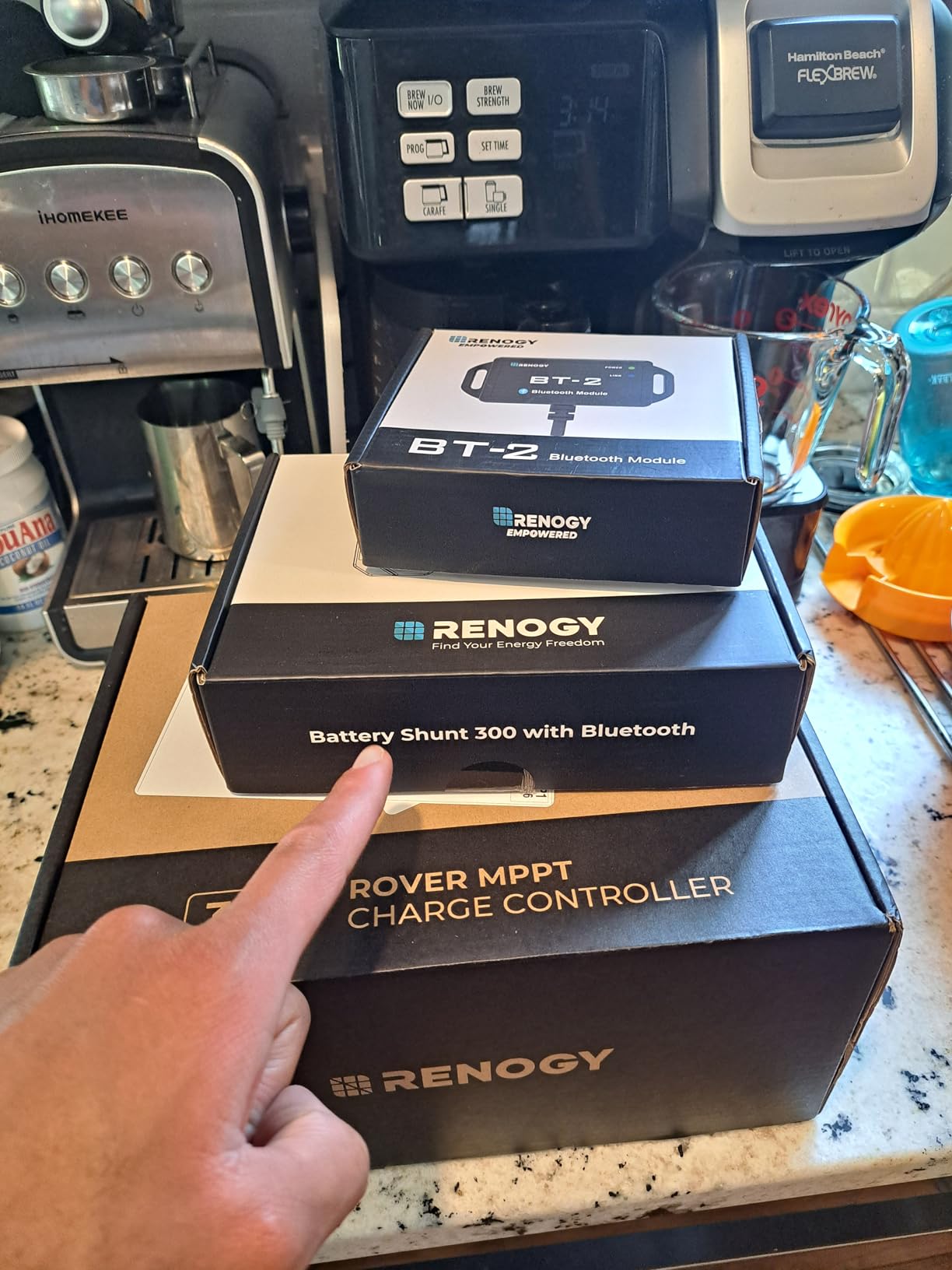
- BT-2 Bluetooth module sold separately
- 3.1 inch wide body eats bay space
- Equalization stage is not needed for lithium
This is the controller that showed up most often in the boondocking forums we read, and it is the one I would put in most rigs without hesitating. One owner on r/RVLiving paired it with three 100W panels and reported the whole setup works well and cheap. That is the endorsement you want, because it is not a spec sheet claim, it is someone who left panels out for a season and was satisfied.
On paper the numbers are strong. Tracking efficiency is quoted at 99.9% with 98% conversion, and the controller accepts up to 400W of PV on a 12V system or 800W on 24V with a 100V Voc ceiling. Temperature compensation runs from -40F to 149F, which matters more in an RV than it does on a roof because your bay can swing wildly between a cold morning and a sun-baked afternoon.
The real reason it wins for boondocking is battery flexibility. It handles gel, sealed, flooded and lithium, and the lithium reactivation mode will wake up a bank that has been sitting deeply discharged, which is exactly the situation a lightly-used trailer finds itself in after two weeks away.
There is a direct DC load output with timer scheduling, so you can run a small 12V fridge or a circulation fan from the controller rather than dragging wires back to the battery. On an r/RVLiving thread, a boondocker running 200W reported never quite topping the batteries off even with panels out all day. That is a real ceiling and worth repeating here. If your daily draw approaches what your panels can harvest, no controller in this list fixes it. You need more panel, not a smarter regulator.
Owners swapping from a factory PWM unit report the harvest gain immediately, especially in winter and under thin cloud, where the voltage gap between panel optimum and battery voltage is widest. The surge protection is a TVS array rated to block 6kV lightning strikes, which is genuine peace of mind with panels bolted to a metal roof twelve feet up.
For a full-time boondocker, one r/RVLiving user recommended at least 600W to 1000W of panels with a 50A MPPT and 300Ah or more of lithium. The Rover 30A is not that controller, but it is the right starting point if you are at 200W to 400W today and want to add a second identical unit later rather than rewire everything.
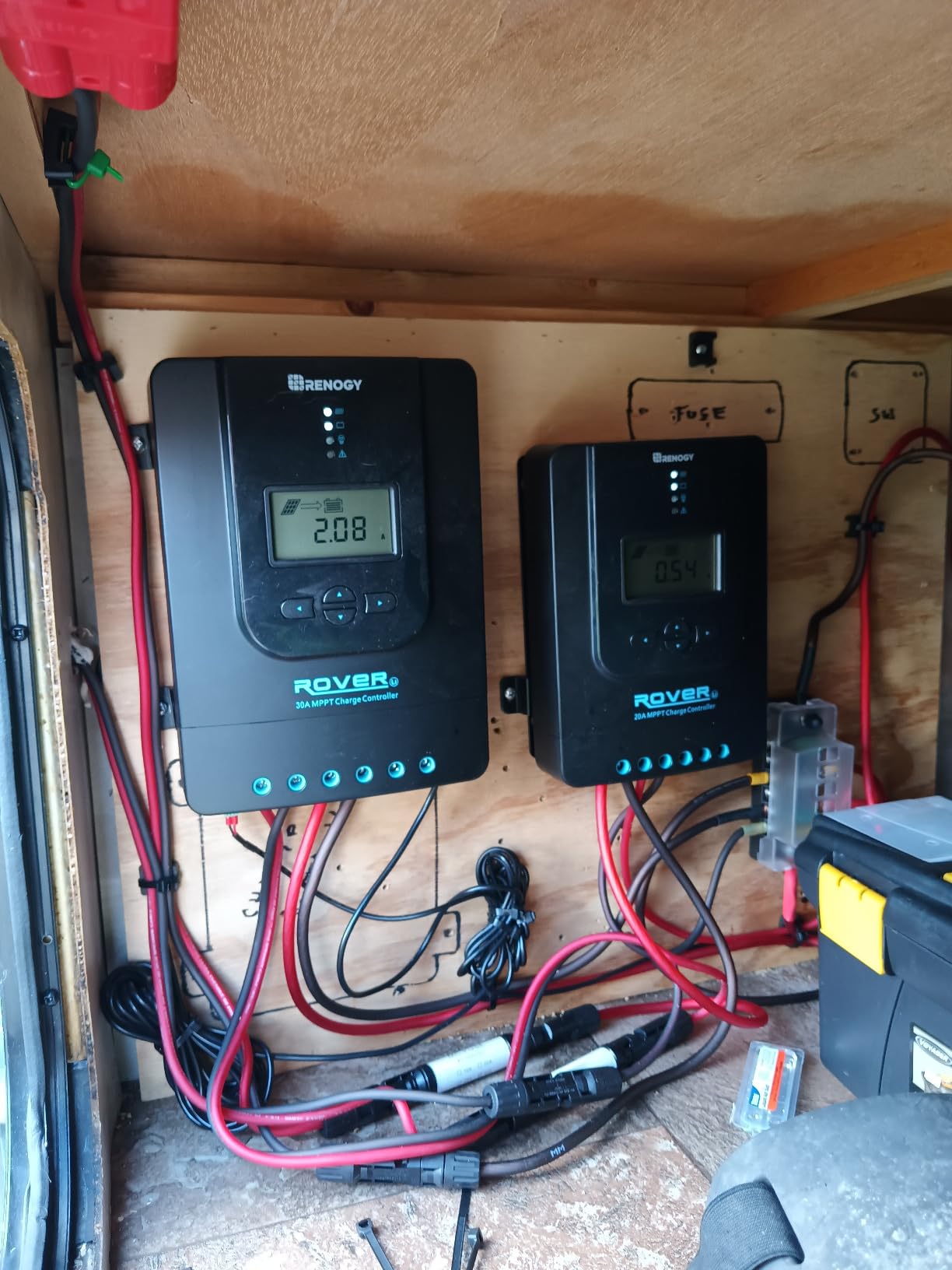
Who the Renogy Rover 30A suits
It suits the majority of RVers who have 200W to 400W of panels and a mixed battery situation, or who plan to add lithium in the next few years. Reviewers consistently praise the lithium support and the reactivation behaviour, and the 4-stage charging with equalization is a real advantage if you keep flooded or AGM bank rather than moving to lithium.
It also suits anyone who wants Bluetooth monitoring but plans for it. The BT-2 module is sold separately, so budget for that if app visibility matters to you. Without the module the LCD still shows you charge state, and the controller keeps working exactly the same.
Where it falls short
The main drawback is physical. At 5.94 by 2.34 by 8.27 inches it is one of the larger bodies here, and cramped compartments do not care about efficiency ratings. If bay space is your binding constraint, the Rich Solar 20A below uses a vertical layout designed for exactly that problem.
Second, the equalization stage is a lead-acid concept that has no place on a LiFePO4 bank, so if lithium is your only future battery you are paying for a feature you will switch off. That is a minor point, but it is worth knowing before you spend time in the menu.
2. Renogy Wanderer Li 30A PWM – Best Budget 30 Amp Controller
Renogy Wanderer Li 30A PWM Solar Charge Controller 12V for Solar Panels
30A PWM
12V only, 25V max PV
IP32 rated, 4.8 ounces
1-year warranty
Pros
- Very compact at 1.8 inch thick
- Lithium jumpstart for over-discharged banks
- IP32 waterproof rating
- Tool-free DIN rail or wall mounting
- Works with lithium
- AGM
- gel and flooded
Cons
- PWM efficiency well below MPPT
- 12V only with no 24V support
- 25V PV ceiling blocks series panels
- 1-year warranty is the shortest here
This is where I will be direct with you: PWM is a genuinely good answer for small systems, and the Wanderer Li proves it. If you are running a single 100W panel and a weekend battery, the efficiency you give up is measured in watt-hours you were never going to harvest anyway. The honest comparison is not MPPT against bad PWM, it is MPPT against PWM on an array too small to show a difference.
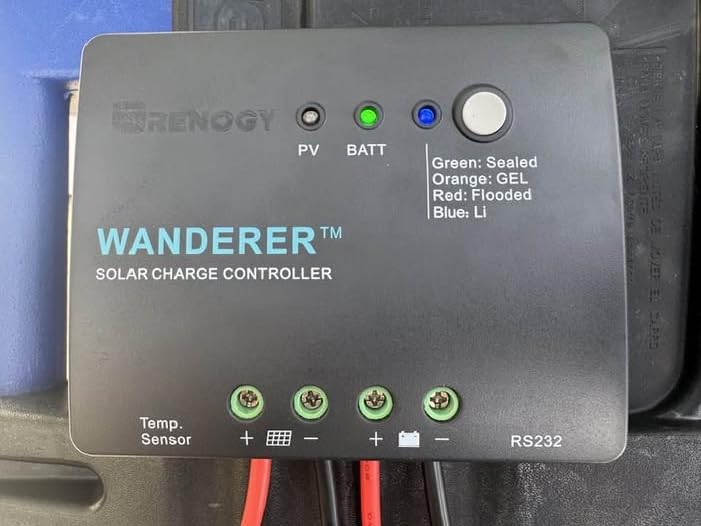
The Wanderer Li is also the smallest unit in this roundup by a wide margin at 6.5 by 4.3 by 1.8 inches and 4.8 ounces. In a trailer bay where every inch counts, that footprint is not a detail. It mounts tool-free on a DIN rail or straight to a wall, and the IP32 rating means humidity is not going to be the thing that kills it.
Battery support covers lithium, AGM, gel and flooded, with a jumpstart function for lithium banks that have been over-discharged. That function matters more than it sounds: a lithium battery that has dropped below its low cutoff can refuse to accept charge from a controller that has not been told to wake it.
Temperature compensation is supported from -4F to 140F, but it needs the BT-1 module to actually receive a battery temperature reading. Without that module the controller runs on its internal sensor, which sits in the bay rather than on the battery. In an enclosed compartment that reading can be optimistic, and optimistic temperature compensation means under-charging in cold weather.
Charge management runs four PWM stages, bulk, boost, float and equalization. The 30A rating is the real number here, but treat it as a ceiling rather than a promise. With a single 100W or 200W panel you will see a portion of the rated amps at midday and far less on a cloudy morning.
Who the Wanderer Li suits
It suits weekend campers, small travel trailers and anyone replacing a factory OEM PWM unit who wants a genuine improvement without a full system redesign. If your existing controller came off the wall of a dealership, swapping to this with proper lithium settings is a meaningful upgrade for a modest outlay.
It also suits anyone who adds panels gradually. A 25V PV ceiling and PWM efficiency do not punish a small array, so starting here and moving up later is a sensible path rather than a compromise.
Where it falls short
It is 12V only. If your rig runs a 24V house bank, this controller is simply not an option, and that rules it out for a meaningful slice of larger motorhomes and bus conversions.
The 25V maximum PV input is the second limit. It means you cannot put two panels in series, which removes most of the flexibility you get with an MPPT controller. If you are planning a 400W array now or later, pick something else.
3. EPEVER Tracer 30A MPPT – Best for Multiple Lithium Chemistries
EPEVER MPPT Solar Charge Controller 30A 12V 24V Auto Max PV 100V
30A MPPT
12V/24V auto, 390W max PV at 12V
99.5% tracking, 98% conversion
RS485 Modbus
Pros
- Highest tracking efficiency figure in our test group at 99.5%
- Supports LiFePO4 and Li(NiCoMn)O2 chemistries
- RS485 and Modbus for real data logging
- Real-time energy statistics
- 390W max solar input at 12V
Cons
- Monitoring needs separate MT50
- MT52 or adapter modules
- Largest footprint of the 30A units
- Warranty not clearly specified
The EPEVER Tracer earns its place for one reason above all others: battery chemistry flexibility. It supports gel, AGM, flooded, sealed, LiFePO4 and Li(NiCoMn)O2, which means if your battery house contains anything other than a standard LiFePO4 pack, this controller still has a correct profile for it. Very few competitors in this list handle more than one lithium chemistry.
Efficiency is quoted at 99.5% tracking and 98% DC to DC conversion, and it takes up to 390W of solar input on 12V or 780W on 24V behind a 100V PV ceiling. For a controller that is not the most expensive thing in the bay, those numbers put it right alongside the premium units.
What makes this the enthusiast pick is the RS485 port with Modbus protocol. That is a wired, reliable data path rather than a wireless handshake, and it is what you want if you are logging real energy statistics across a season of boondocking instead of occasionally peeking at an app. Optional MT50 and MT52 remote meters, a WiFi adapter, a BLE adapter and a USB to RS485 cable are all supported.
Battery temperature compensation is built in, which matters for anyone charging through winter. The LCD gives you live status, and the unit is a 12V and 24V auto-recognition model, so the same box works if you upgrade your house bank voltage later.
The 8.98 by 6.46 by 2.17 inch body at 1.26 kilograms is the largest footprint of the 30A controllers here. In a tight compartment, that is a real trade. Budget for it, or plan the install around it rather than discovering the conflict with the battery box.
Who the EPEVER Tracer suits
It suits owners who want hard data on their system, who have an unusual lithium chemistry, or who want to add a remote meter and log charge cycles properly across a full-time boondocking year. If you are the kind of person who reads the charging log, this is the controller built for you.
It also suits anyone whose panels outrun a 30A PWM setup and who wants efficiency without stepping up to a premium price band. Against the other MPPT units in this list, the efficiency gap is small; the monitoring depth is where it pulls ahead.
Where it falls short
Monitoring costs extra. The Bluetooth and WiFi story requires an additional module, and if you want phone visibility out of the box this is not the controller. The LiTime below includes Bluetooth in the box.
Review volume is far lower than the Renogy units, at 217 reviews against more than 4000 on the Rover. A strong 4.5 rating is encouraging, but a thinner long-term record means you are buying on specifications more than on a decade of field reports.
4. LiTime 30A MPPT – Best for Built-In Bluetooth Monitoring
LiTime 12V/24V 30A MPPT Solar Charge Controller Bluetooth, LCD Display
30A MPPT
Bluetooth built in, no module needed
450W max PV at 12V, 900W at 24V
2-year warranty
Pros
- Bluetooth is built in rather than a separate module
- 99% tracking and 98% peak conversion
- Die-cast aluminum housing sheds heat
- LiFePO4 charging mode plus sealed
- gel and lead-acid
- Copper wire connectors included
Cons
- App had compatibility issues on newer Android versions
- Bluetooth range is limited
- 4.4 pounds is heavy for a 30A unit
Most MPPT controllers in this price bracket make monitoring an upsell. This one does not. The Bluetooth is in the box, the app is free, and there is no module to add later, which removes the single most common complaint we heard about otherwise capable controllers.
It also pushes the input ceiling higher than most 30A units, taking up to 450W of panel on a 12V system and 900W on 24V, with 12V and 24V auto-detection. Efficiency is quoted at 99% tracking and 98% peak conversion, so the numbers sit right at the top of the group.
The die-cast aluminum housing is a genuinely good decision in an RV. A bay in full sun can push well past the 45C operating temperature, and aluminum moves that heat away from the electronics rather than letting it sit. Controllers that hiss or throttle in a hot compartment are usually plastic bodies with nowhere to put the heat.
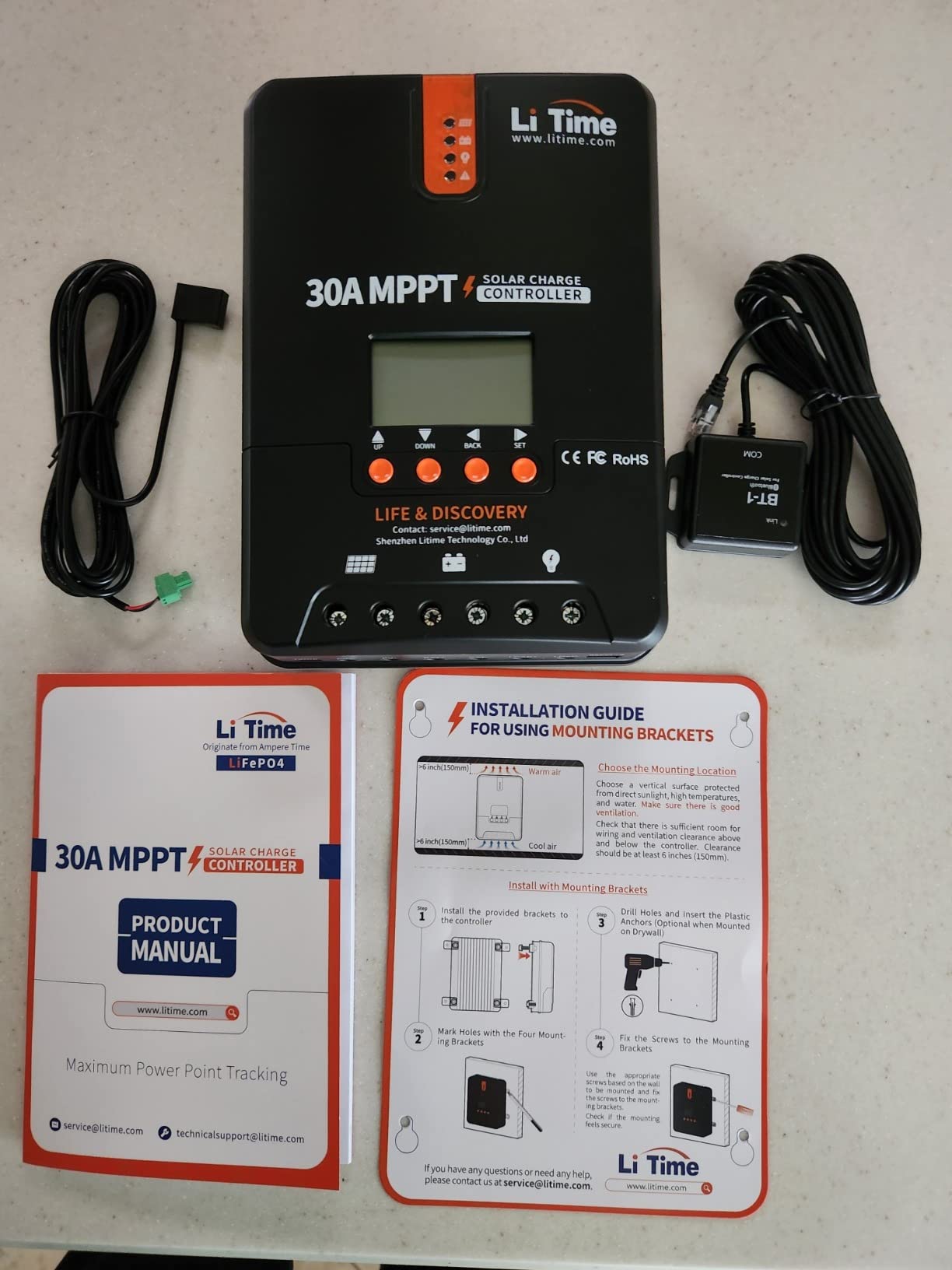
Protection coverage is broad: reverse connection, overpower, overvoltage, short circuit and over-temperature. The LCD is a 4-button menu display with LED status indicators, and copper wire connectors are included, which is better than the tinned terminals you get on some budget units because copper holds conductivity better in a damp bay.
There is a dedicated LiFePO4 charging mode alongside sealed, gel and lead-acid compatibility, plus a 2-year warranty backed by AIG product liability insurance. That warranty length sits between the 1-year PWM units and the 3-year Renogy coverage.
Who the LiTime suits
It suits boondockers who want to check state of charge and daily harvest from their phone without buying a separate module, and who want Bluetooth as part of the build rather than a later upgrade. It is also a solid fit for LiFePO4 owners who want a mode labelled for their chemistry rather than a generic lithium setting.
At 4.4 pounds it is the heaviest 30A unit here, so plan the mounting with that in mind. Aluminum mass is heat management, but it is still mass hanging in a bay.
Where it falls short
The app had compatibility issues on newer Android versions. Reviewers describe these as resolved, but if most of your monitoring happens on a phone, check the current app before you commit.
Bluetooth range is limited, meaning you need to be fairly close to the controller to connect. Inside a metal-walled bay that distance can be short, so plan on pairing from outside or near an access panel.
5. AMPINVT 60A MPPT – Best for Large 400W-Plus Arrays
Ampinvt MPPT Solar Charge Controller 60A 12V 24V 36V 48V Battery System Auto,Max Input 150V PV Solar Panel Regulator for AGM Sealed Gel Flooded Lithium Battery
60A MPPT
12V, 24V, 36V and 48V support
150V max PV input, 900W at 12V
RS485 with optional WiFi
Pros
- Only 60A unit here
- with 36V and 48V system support
- 150V PV ceiling allows series panel strings
- Tracking rate at 99% and conversion above 98%
- LCD with daily power generation curves
- One-key factory reset
Cons
- No manufacturer warranty
- reviewers report display failures
- Customer support reported as weak
- DC load output limited to about 10A
Everything else in this roundup tops out at 30 amps. This one does not, and for the full-time boondocker running a serious array it is the only pick here rated to take the whole thing without a second controller. The specifications are the widest in the group: 60A, 12V, 24V, 36V and 48V battery support, and a 150V maximum PV input.
The 150V ceiling is the feature that changes what you can build. It means two or even three panels can be wired in series without an external optimizer, which cuts current losses and dramatically reduces the cable run from the roof. Max solar input is quoted at 900W on 12V, 1700W on 24V, 2700W on 36V and 3400W on 48V.
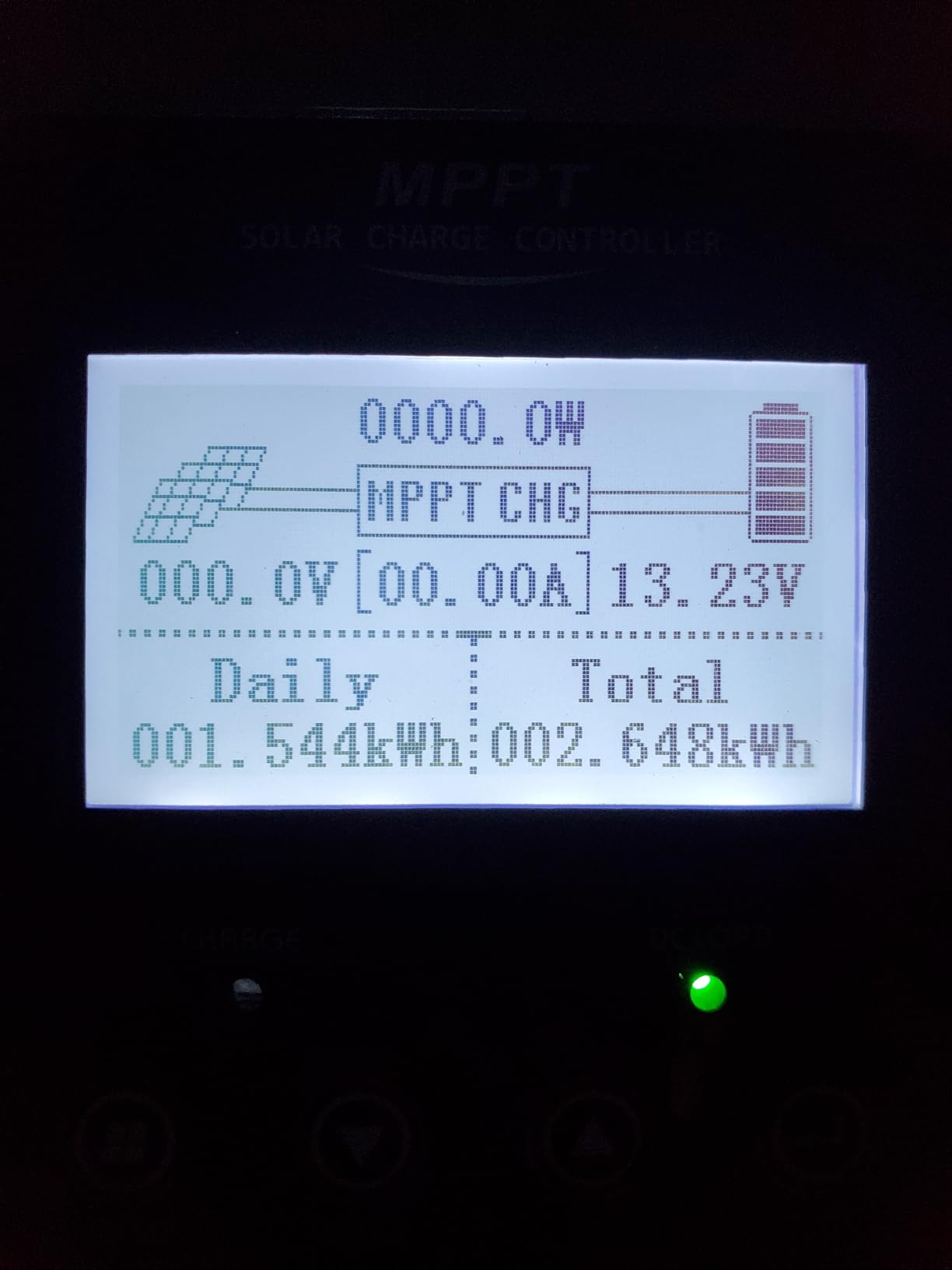
Monitoring is RS485 based with optional WiFi, and it drives both an app and a set of on-screen daily power generation curves. There is a user-defined battery type setting alongside sealed, gel, AGM, flooded and lithium presets, plus a one-key factory reset when you inevitably fat-finger a menu.
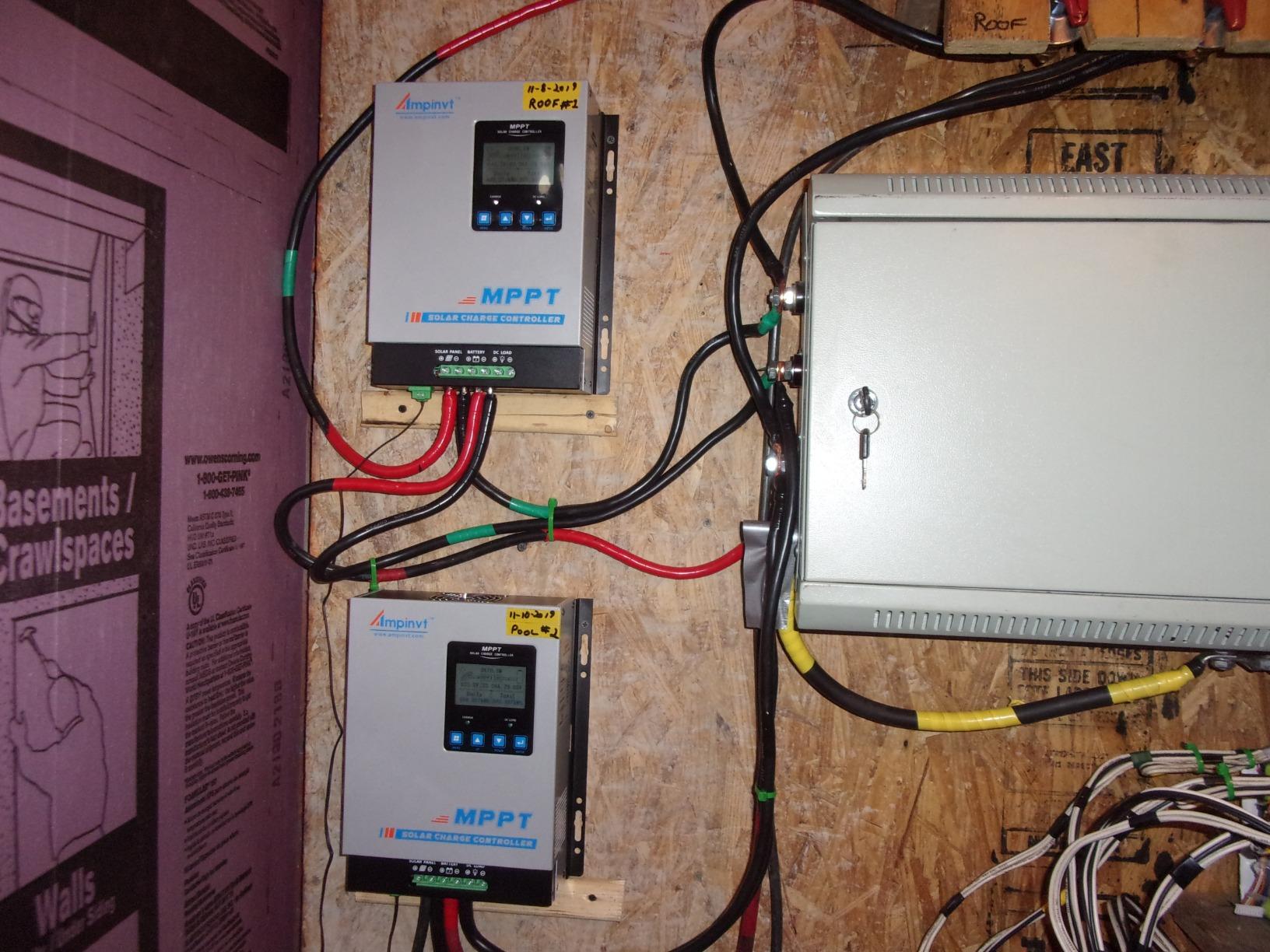
Protection is comprehensive, covering overcharge, over-discharge, overload, short circuit, reverse polarity, overheat and battery under-voltage. That last one matters on long boondocking stretches where a bank can drift down further than you expect overnight.
I want to be straight about the reliability reports, because they are consistent and they are the reason this is not the number one pick. Multiple reviews mention display failure after roughly two months, and several describe customer support as poor. The 4.2 rating is the lowest among the MPPT units here for a reason.
Who the AMPINVT suits
It suits the full-time boondocker with 400W to 900W of panels who needs one controller to do everything, or anyone running a non-standard 36V or 48V bank. Nothing else on this list covers those voltages, and the 150V ceiling makes series strings genuinely practical.
It also suits anyone who has been quoted a much larger controller than their array needs and wants headroom. The wide voltage window means the box will accept whatever you hang on it.
Where it falls short
The warranty is the deal-breaker for most people. It carries only the Amazon 30-day guarantee with no manufacturer warranty, which is a sharp contrast to the three years on the Renogy Rover.
Beyond that, the display and support complaints are real, and load output is limited to about 10A, so you cannot use it to run a fridge or fan directly the way the Rover can. If reliability is the priority over maximum capacity, take the 30A MPPT instead.
6. ECO-WORTHY 30A PWM – Best for USB Device Charging on the Road
ECO-WORTHY 30A 12/24V PWM Solar Charge Controller with Bluetooth
30A PWM
12V/24V auto-detection
Built-in Bluetooth, 98 ft range
Dual USB 5V 2.5A output
Pros
- Built-in Bluetooth with no separate module
- Dual USB ports for phones and laptops
- 12V and 24V auto-detection
- Measurement accuracy under 1% error
- Lithium phosphate support
- Low voltage cutoff at 8V
Cons
- PWM efficiency below MPPT
- Load output limited to 10A
- Runs warm during operation
- No manufacturer warranty stated
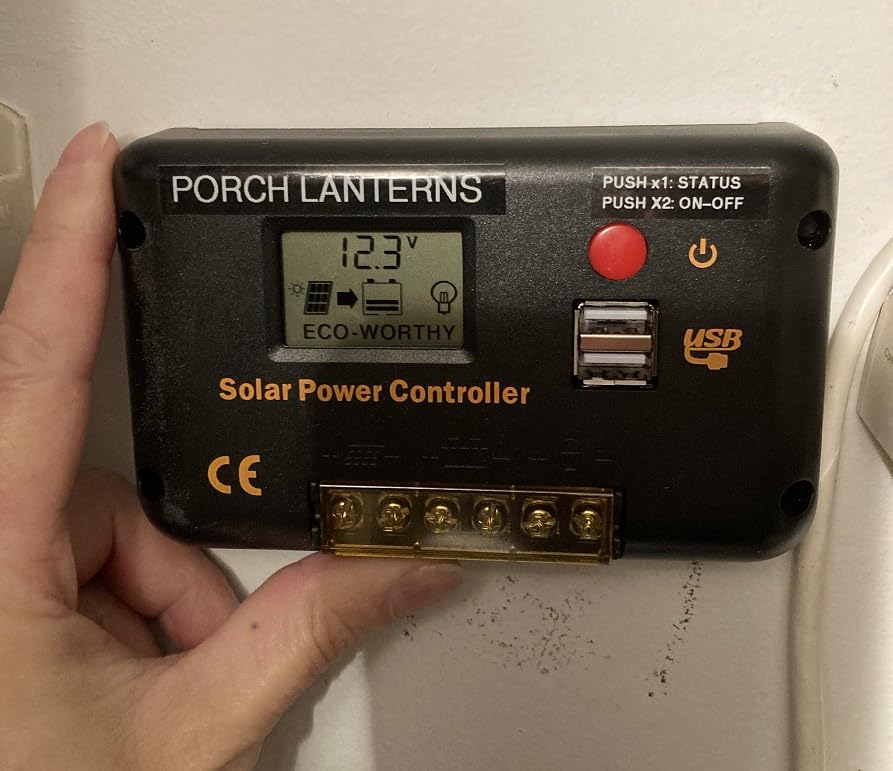
The reason this unit earns a place is a pair of USB ports rated 5V at up to 2.5A. For a boondocker who works from the rig, that is a genuinely useful output, and no other controller on this list has one. Combined with a 10A discharge output, it turns the controller into a small power distribution point rather than just a regulator.
Bluetooth is also built in, with a stated 98 ft range, and there is no module to buy. Monitoring shows voltage and current with measurement accuracy under 1% error, which is unusually honest for a PWM unit and good enough to trust for real numbers.
Battery support covers lead acid, gel and lithium phosphate, with a low voltage cutoff at 8V to protect the bank. Charging runs three PWM stages, and a dual MOSFET design handles reverse current protection and keeps heat generation down.
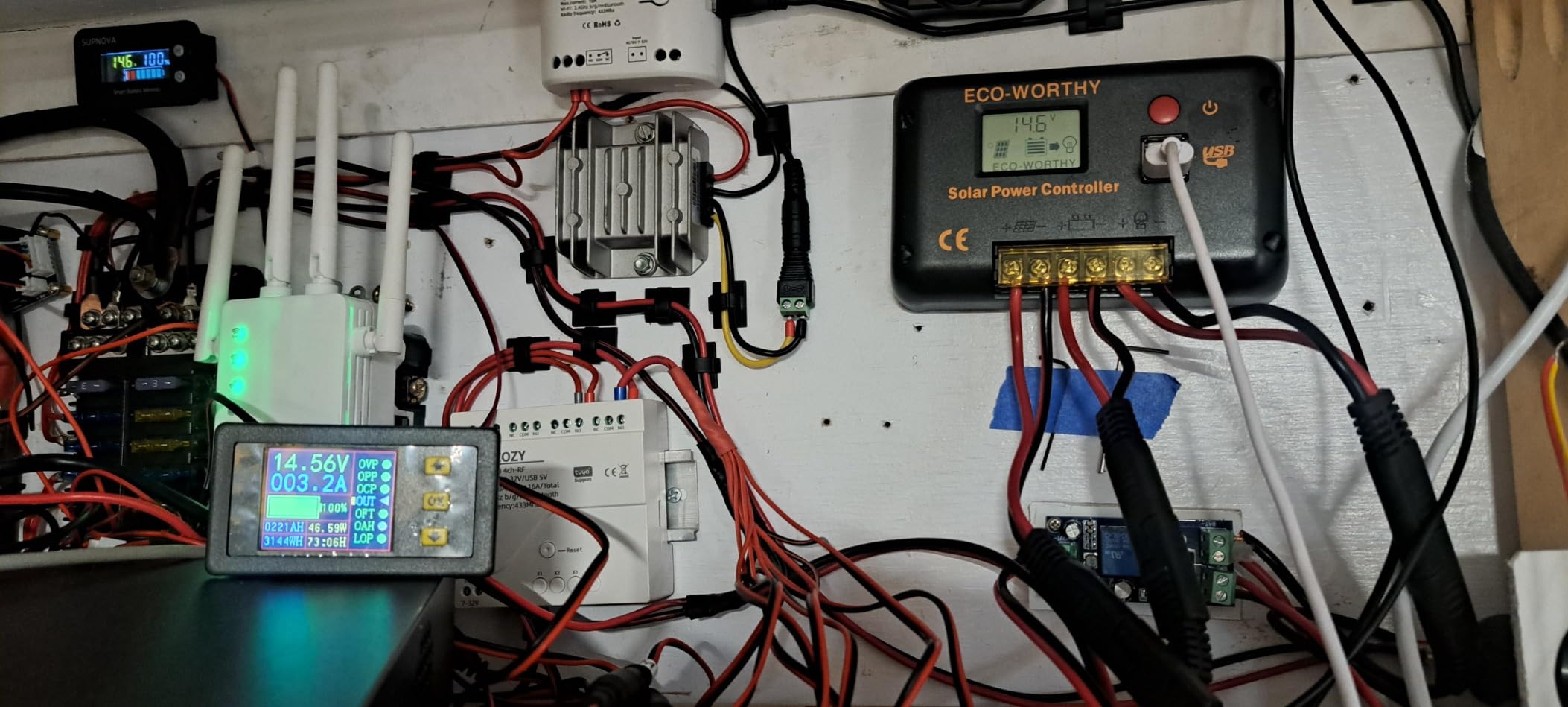
The 4.0 rating is the joint lowest here alongside the BougeRV, and the review summary points at PWM efficiency as the limiting factor. That is the correct read. Do not put this in front of a 400W array and expect MPPT-class harvest.
Reviewers do note the controller heats up during operation. In a closed compartment with limited airflow, that is worth taking seriously. Mount it where moving air can reach it rather than sealed behind a panel.
Who the ECO-WORTHY suits
It suits digital nomads and work-anywhere campers who want USB charging plus phone monitoring without buying two separate accessories. A 12V or 24V system with a modest panel array and a genuine need for device power is the sweet spot.
It also suits anyone building a simple system where the load output actually gets used. The 10A discharge path is more useful here than on most competing units because of the USB pairing.
Where it falls short
PWM efficiency is the core limitation. Below about 200W of panel, that cost is small. Above it, you are giving away real energy every clear day.
No manufacturer warranty is stated, and the 4.0 rating across 314 reviews is the second lowest in this group. For a temporary or secondary role in a system, that is a reasonable trade. As your only controller on a full-time rig, it is thinner than the alternatives.
7. BougeRV Li 30A PWM – Best Backlit Display for Dark Compartments
BougeRV Li 30A PWM Solar Charge Controller 12V 24V with Backlit Display
30A PWM
12V and 24V support, 55V max PV
Backlit LCD
18-month warranty
Pros
- Backlit LCD is readable in a dark bay at night
- Icons for LFP
- ternary lithium and LTO chemistries
- Lithium jumpstart recovers over-discharged packs
- Spade terminals included for clean wiring
- 18-month warranty
Cons
- No Bluetooth or app connectivity
- 55V PV ceiling limits series configurations
- Load output around 10A
- Review volume of 221 is modest
The backlit display is the reason to pick this over the other budget PWM units, and it is a better reason than it first appears. Most RV bays are unlit. Checking charge state means shining a phone light at a reflective screen while holding a flashlight, and the backlit LCD here drops to 50% brightness in standby so it stays readable without lighting up the whole compartment.
The screen cycles PV current and battery voltage every three seconds, which is enough to tell you whether the system is actually producing and how full the bank is. That is the information you need at the end of a boondocking day.
Battery type selection is unusually granular. You get dedicated icons for LFP, ternary lithium and LTO chemistries, plus compatibility with SLD, flooded, gel, AGM and SLA. A lithium jumpstart function handles packs that have been over-discharged. That is real chemistry support, not one generic lithium label.
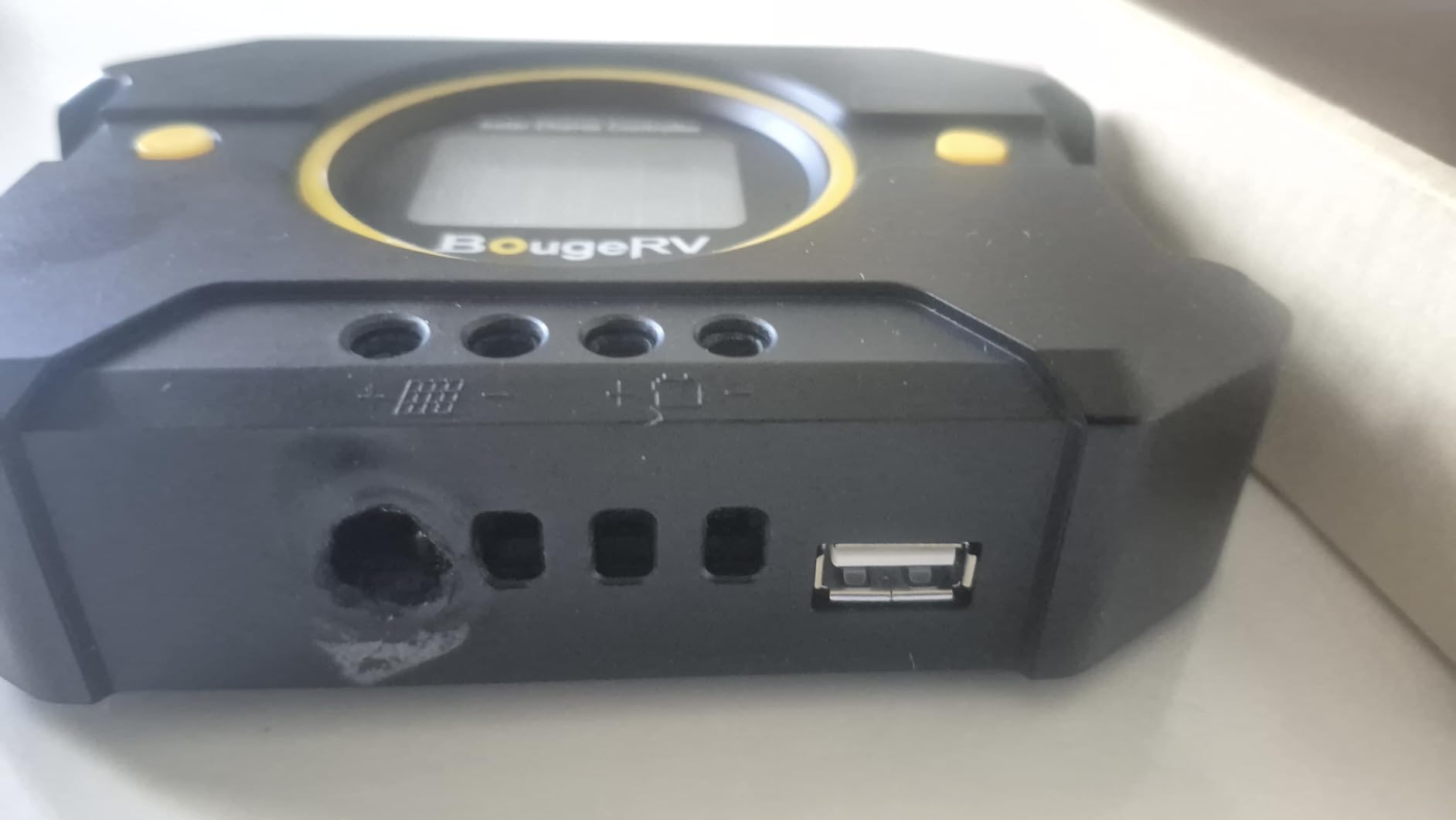
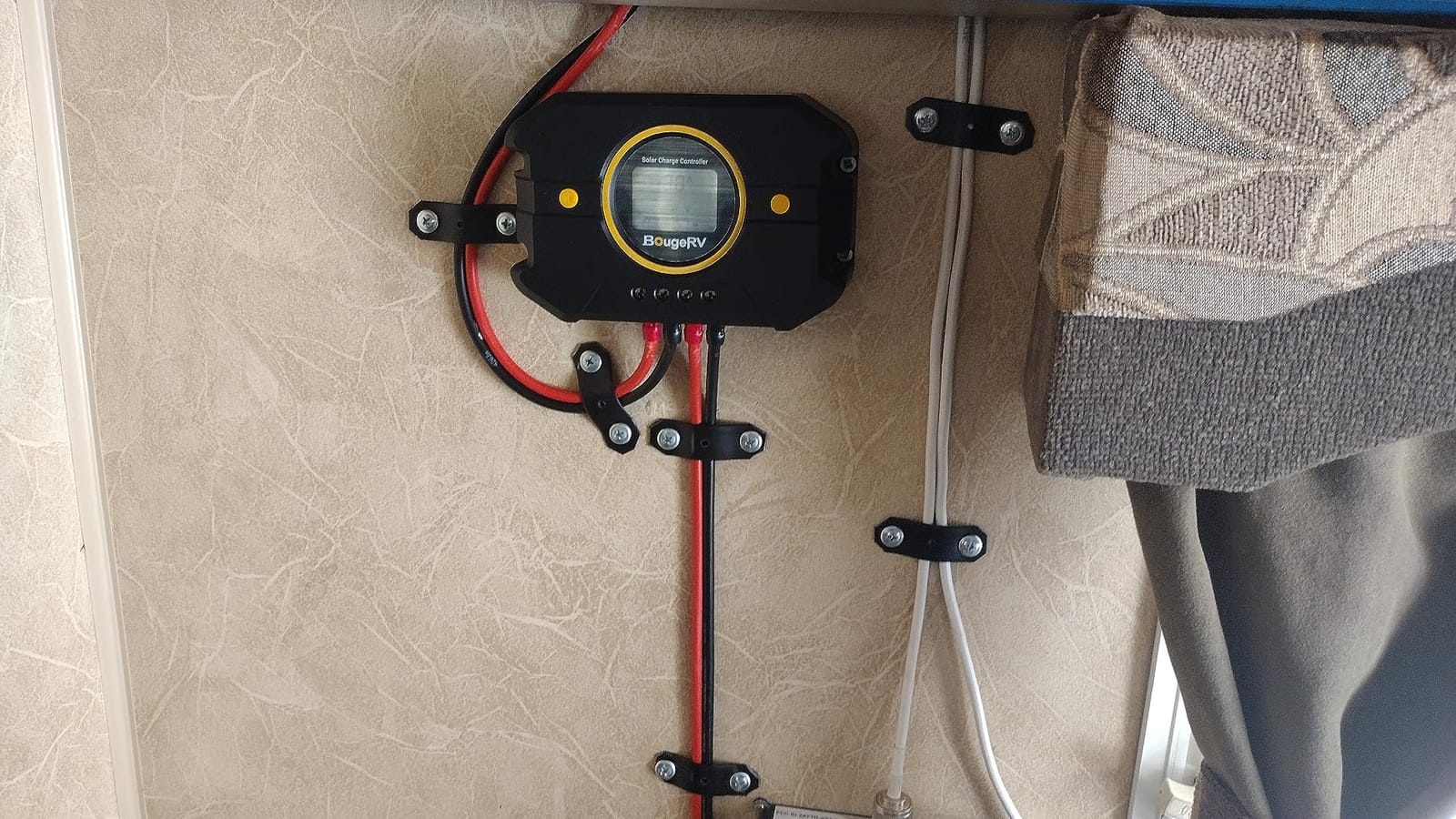
Physical size is a genuine strength at 5.92 by 3.95 by 1.92 inches, and three pairs of spade terminals are included so the wiring ends up tidy instead of a bundle of loose ring connectors. The PV ceiling is 55V, which is higher than the other PWM units here and allows a modest series connection, with 450W max solar input at 12V and 900W at 24V.
The 18-month warranty sits in the middle of this group, better than the one-year PWM coverage and shorter than the three-year Renogy. A dual MOSFET design handles reverse current protection and low heat generation.
Who the BougeRV Li suits
It suits anyone checking their system in the dark, in an older trailer, or with a bay that is genuinely hard to light. It also suits owners with an unusual lithium chemistry, since the LFP, ternary and LTO icons cover three very different battery families in one menu.
It is a good value replacement for a factory PWM unit where the original was wired into a tight space and the terminals were a mess. The included spade terminals make that job much easier.
Where it falls short
There is no Bluetooth and no app. Monitoring stops at the display, which is fine if you check physically and not fine if you want to see harvest history from the cab.
Load output sits around 10A, so it cannot run a fridge directly, and the 55V PV ceiling is still tight for larger series strings. If you are past 300W of panels, move up to an MPPT.
8. Rich Solar 20A MPPT – Best for Compact RV Solar Bays
RICH SOLAR 20A MPPT Solar Charge Controller – High-Efficiency 12V/24V Auto Detection, 99% Tracking, Rugged Design for RVs, Boats & Off-Grid Systems
20A MPPT
12V/24V auto-detection
99% tracking, 98% conversion
Die-cast aluminum, 3.1 pounds
Pros
- Vertical layout designed to fit RV battery bays
- MPPT efficiency on a 20A budget
- Die-cast aluminum construction
- Battery recovery mode for deeply discharged banks
- Temperature sensor input
- Full electronic protection suite
Cons
- 20A is the lowest rating in the group
- Bluetooth needs a separate BT-1 module
- 20A caps your future array size
- Warranty not specified
This is the controller to buy when the bay is the problem rather than the panels. The vertical wall-mount layout is designed for RV compartments specifically, and the body is 8.27 by 5.94 by 2.34 inches with a narrow footprint that sits against a wall rather than across it. At 3.1 pounds in die-cast aluminum it stays put under vibration, which matters on a rough forest road.
You still get MPPT performance at 99% tracking and 98% conversion on a 20A rating, with 12V and 24V auto-detection. A lot of people assume a smaller controller means a cheaper technology. This is the pick that proves otherwise, and it is the one I would recommend for a 200W to 300W system in a small trailer.
The battery recovery mode is worth calling out. If your bank has been sitting undercharged for a season, recovery mode walks it back up rather than leaving it stranded. Combined with customizable charging profiles, a temperature sensor input and support for lithium, AGM, gel and flooded, it is a well-rounded menu for the chemistries RVers actually own.
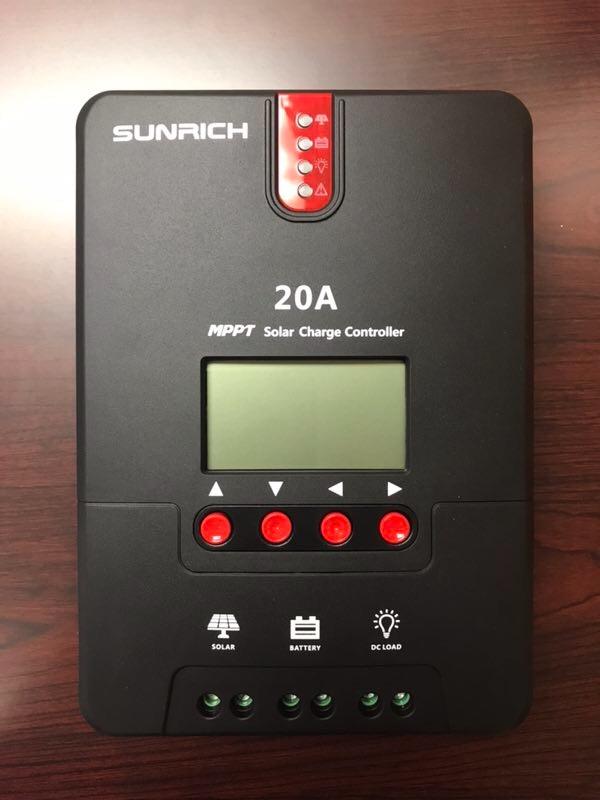
The bold tactile buttons and clear LCD are easier to operate in a cramped space with work gloves on than a membrane keypad would be, and full electronic protection covers overcharge, reverse polarity, short circuit and overload.
Operating temperature is rated to 113F, which is worth noting for a bay in direct sun. Bluetooth is available through the RS232 port with a BT-1 module, so monitoring is an add-on rather than a feature.
Who the Rich Solar suits
It suits small trailer owners and Class C campers where 20 amps is genuinely enough and bay dimensions are the real constraint. It also suits anyone who wants MPPT efficiency without a large body, and it pairs neatly with a 200W panel for a clean weekend boondocking build.
It is a sensible second controller too. If your first install used 20A of headroom, adding a second identical unit later is simpler than mixing technologies in one system.
Where the Rich Solar falls short
Twenty amps is the lowest current rating in this roundup, and it puts a ceiling on the array. Max solar input scales with the controller, so a 20A unit constrains you to roughly 300W before you are relying on the conversion headroom the design already uses.
Bluetooth costs extra and the warranty is not specified. If you want phone monitoring out of the box, the LiTime is the better fit at a similar size.
How to Size an RV Solar Charge Controller
Divide your total panel watts by 0.8 to get the minimum raw capacity your controller needs, and then convert that to amps against your system voltage. The 0.8 accounts for conversion loss inside the controller itself, so a 400W array needs at least 500W of controller capacity, which in practice means you round up to the next available controller size.
Worked examples from the units in this roundup, using that formula:
100W of panel needs about 8A, so a 20A controller has plenty of headroom.
200W of panel needs about 16A, so a 20A or 30A controller is right.
300W of panel needs about 22A, so a 30A controller is the minimum sensible choice.
400W of panel needs about 28A, so a 30A controller works and a 60A controller gives expansion room.
600W of panel needs about 42A, so a 60A controller is the smallest fit.
The formula is the same on 24V systems, but your panel wattage per amp requirement is different, so the controller choice changes. If you already know your panel situation, our RV solar panel kit roundup covers matching panels to your daily energy use.
Two sizing traps catch people out. The first is the PV input voltage ceiling, which is separate from the amp rating. A controller with a 25V or 55V ceiling cannot accept panels in series even if the amps would allow it, so check Voc before you plan a series string. The second is oversizing out of fear. Sizing confusion runs through every RV solar forum, and owners regularly move up several sizes and report never seeing the difference. Buy for the array you have plus one expansion step, not for the array you might have in five years.
MPPT vs PWM: Which One an RV Actually Needs
MPPT for 200W and above, and for any lithium setup. PWM is genuinely fine for a single small panel on lead acid, and below that threshold the efficiency you lose is smaller than the money you keep.
An MPPT controller tracks the true maximum power point of the panel and converts that higher panel voltage down to battery voltage efficiently. A PWM controller simply chops the panel output to whatever the battery voltage happens to be. The gap between those two numbers is typically a 20 to 30% harvest difference, and it widens when the panel voltage is highest relative to the battery.
That last part is the RV-specific detail. Cold mornings and thin winter cloud push panel voltage up, which is exactly when MPPT pulls furthest ahead. On a hot summer afternoon with a battery already near full, the two technologies converge. If you boondock seasonally, winter performance is where your extra harvest actually shows up.
There is also a hard efficiency ceiling. PWM typically runs around 70 to 80% conversion where the MPPT units in this list quote 98% or better. On a 400W array in bright conditions, that difference is a meaningful chunk of your daily harvest.
Our wider guides cover the technology in more depth for non-RV builds: the MPPT charge controller roundup and the general solar charge controller roundup both go deeper on the electronics.
Lithium Battery Settings and Charge Profiles
Do lithium batteries need a special solar charge controller? Any controller that lets you select a lithium charge profile will work safely with LiFePO4, because the profile is what changes the absorption and float voltages. A controller that only offers lead-acid presets is the problem, not the lithium battery.
What changes between chemistries is the voltage setpoints, and this is where most lithium charging complaints originate:
LiFePO4 typically uses a bulk stage up to around 14.4V on a 12V system, a short or absent absorption stage, and a float around 13.4V.
AGM and gel use a fuller absorption stage and a float around 13.7V to 13.8V.
Flooded lead acid wants the longest absorption stage and a float near 13.5V, plus periodic equalization.
Ternary lithium and LTO chemistries sit at different setpoints again, and only a few controllers offer them as named profiles.
Two lithium safety points deserve attention. The first is cold weather. Several iRV2 threads caution against charging LiFePO4 below freezing, and some MPPT charge profiles will do it by default because the controller is following a lead-acid temperature compensation curve. Set the lithium profile, confirm your low-temperature cutoff, and do not leave a bank charging through a hard freeze.
The second is the BMS. Most LiFePO4 packs have an internal battery management system that disconnects on low voltage, over current or over temperature. Your controller does not need to know the BMS exists, but it does need to stay within the pack’s charge voltage and current limits. A 30A controller on a small 50Ah pack is overdriving it.
If your lithium battery is not charging from solar, work through this order:
Confirm the controller battery type is set to lithium and not left on flooded or sealed.
Check the charge state actually reached. A bank at absorption or float is charging, and the controller will show near zero current doing it.
Verify the battery-to-controller cable is sized and the inline fuse is intact.
Check that the controller was connected to the battery before the panels, so it read battery voltage correctly on power-up.
If the bank has dropped below its BMS cutoff, use the controller jumpstart or recovery function if it has one.
Replacing a Factory OEM RV Charge Controller
Most factory-installed controllers are entry-level PWM units, and swapping yours is the single most common solar upgrade an RV owner makes. Connect the battery to the new controller before you connect the panels, and disconnect in the reverse order.
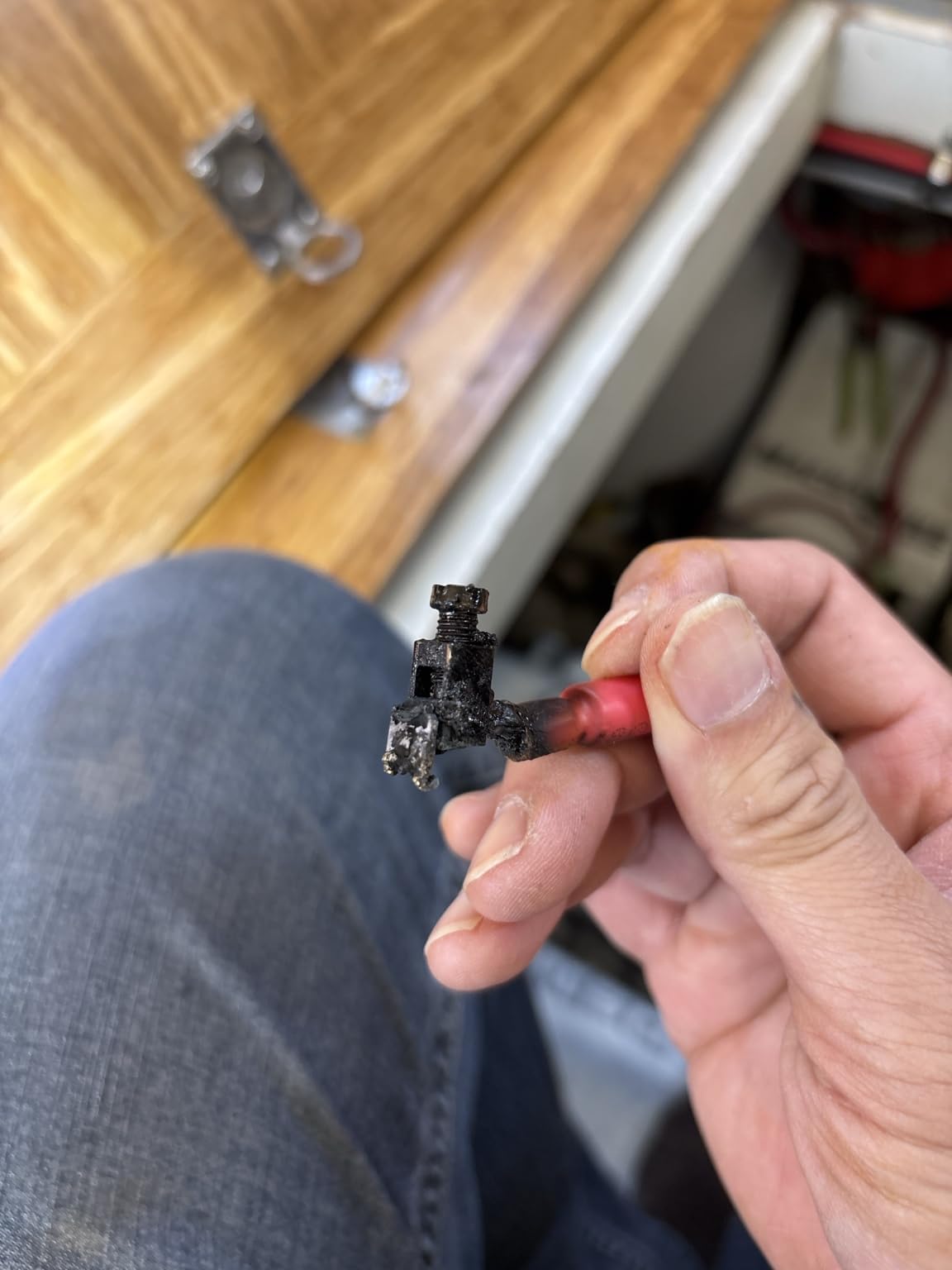
That wiring order is not a formality. A mygrandrv owner described the failure mode directly: if the controller was hooked up to solar before a battery, it assumed a system state that was wrong. Forum reports of fried control boards and blown fuses after lithium upgrades cluster around this one mistake.
The sequence itself is short:
Cover or disconnect the panels so no power reaches the controller during the swap.
Identify what you have. Note the current controller model, its battery type setting and which terminals run where.
Remove the old controller and its wiring, photo or diagram the layout first.
Mount the new controller in a ventilated position, and keep it away from the battery if your cable lengths allow.
Connect the battery side to the controller with an inline fuse sized to the controller output, not to the cable.
Set the battery type to match your chemistry before anything else.
Connect the panels last, then confirm charge current appears on the display.
On shutdown, reverse the order. Panels off, then battery. The inline fuse between controller and battery is not optional, and it is the cheapest insurance in the whole install.
Frequently Asked Questions
What is the best solar charge controller for an RV?
For most RVers running 200W to 400W of panel, the Renogy Rover 30A MPPT is the strongest all-round choice. It tracks at 99.9% efficiency, accepts up to 400W at 12V, handles lead acid and lithium, and is backed by a 3-year warranty. Smaller systems can use a 20A MPPT such as the Rich Solar, and large arrays need a 60A unit.
How many watts of solar can a 30 amp charge controller handle?
Divide your panel watts by 0.8 to find the minimum amps needed, so a 30A controller handles roughly 375W of panels. In practice the 30A units in this roundup are rated to 390W, 400W and 450W depending on the model, with a 100V or 150V maximum PV input voltage limit.
Why is my lithium battery not charging from solar?
The most common cause is the charge profile. If the controller is still set to flooded, sealed or gel, it applies lead-acid voltages that a LiFePO4 pack will not accept properly. Check the battery type setting first, then confirm the bank has not dropped below its BMS cutoff, and use the jumpstart or recovery function if it has one.
Do I need a charge controller with one 100W panel?
Technically the panel is below the controller threshold, but you still need one. Without a controller your battery will overcharge on clear days and drain back through the panel each night. A budget PWM unit is entirely adequate for that array size, and a 20A controller leaves room to add panels later.
Does a 200W solar panel run a 12V fridge?
Not reliably on its own. A 200W panel yields roughly 600 watt-hours on a good sunny day, and a typical 12V fridge-freezer draws around 40 to 50 amp-hours a day once you account for duty cycle. It will keep a fridge running in mild conditions, but shade, heat and compressor startup draw quickly consume the surplus. Add a second panel or plan on a generator for hot weather.
The Best RV Solar Charge Controllers for Boondocking in 2026
The Renogy Rover 30A MPPT is the default recommendation, and it earns that place on review volume, battery flexibility and a three-year warranty rather than on any single specification. If your bay is the constraint, the Rich Solar 20A MPPT gives you the same technology class in a body shaped for an RV compartment. If you want phone monitoring without buying a module, the LiTime 30A has Bluetooth built in.
PWM still has a place. The Renogy Wanderer Li and the BougeRV Li both handle a single small panel and a lithium bank competently, and if your array never passes 200W the efficiency difference will not pay for itself. The one thing not to compromise on is setting the battery type correctly the first time.
For the rest of your boondocking kit, our RV accessories roundup covers the pieces that sit either side of the controller in the chain.