
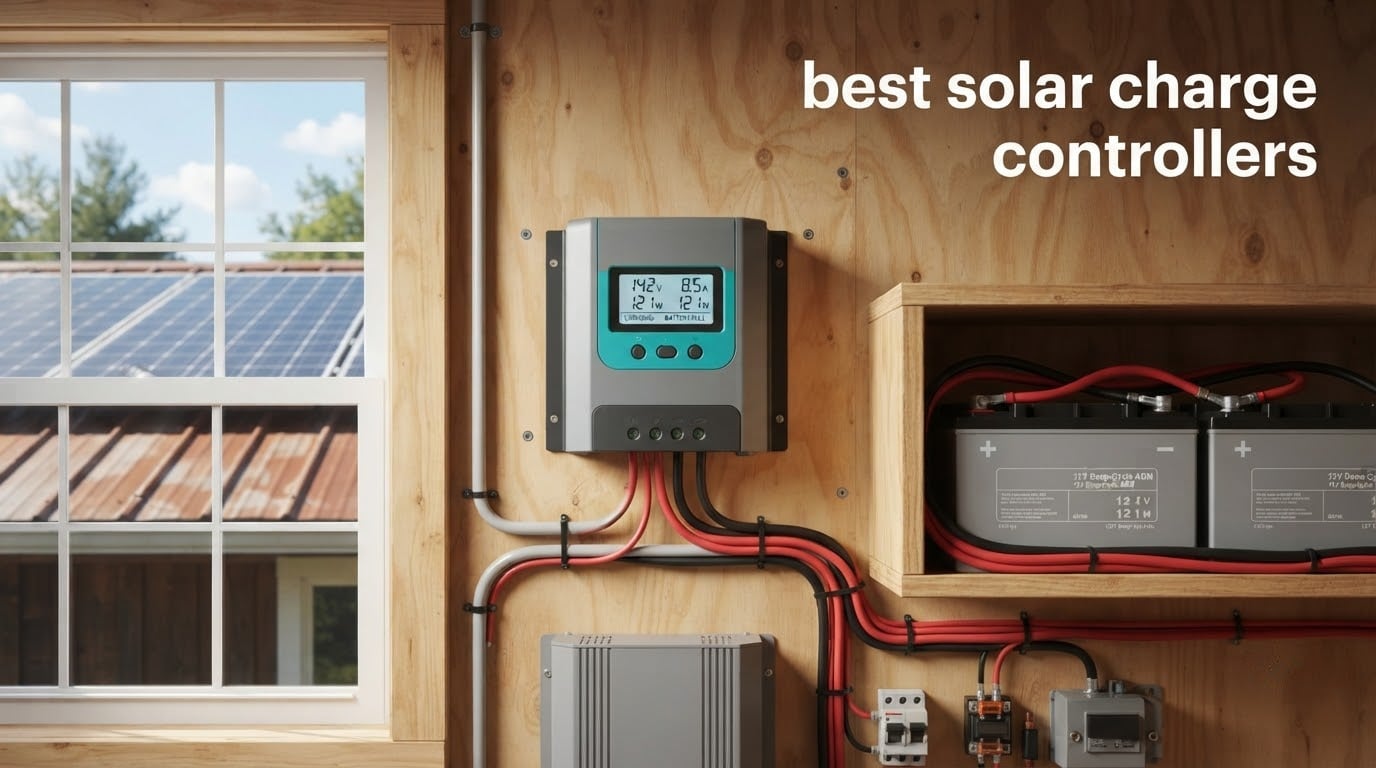
A solar charge controller sits between your panels and your battery bank, regulating charging current and voltage, tracking the array’s maximum power point, and blocking reverse current at night so the battery does not drain backwards through the panels. Without one, an array will boil a lead-acid battery dry or overcharge a lithium pack. If you have panels and a battery bank, you need one, no matter how small the system.
That simple requirement is where most buying guides go wrong. They rank controllers by amperage on a spec sheet, and they hand you a list of ten models that all look interchangeable until you notice one has no lithium profile, another needs a Bluetooth dongle you have to buy separately, and a third reports a battery voltage two-tenths of a volt higher than a multimeter does. Small differences like those decide whether a controller sits quietly in a cabinet for ten years or gets swapped out in a year.
For this roundup of the best solar charge controllers, our team worked through the full category: budget PWM units, entry MPPT, mid-range MPPT, and the premium tier where support and enclosure quality start to matter. We compared rated charge current, maximum PV input voltage, battery chemistry support, temperature behavior, monitoring options, warranty length, and the terminal and build details that decide whether a controller survives a real installation. We also focused on two things forum users complain about more than anything else: how accurate the reported battery voltage is, and whether the controller actually transitions stages the way it should in full sun.
The result covers everything from a single 100W panel on a shed to a 1200W array on a camper van, and it is organized so you can self-select fast. If you are pairing controllers with new panels or batteries, our best solar panels for van conversions and best solar batteries for RVs guides cover the rest of the chain.
Table of Contents
Top 3 Picks for the Best Solar Charge Controllers in 2026
Three models came out ahead once we weighed rating, review volume, feature completeness, and how much extra cost sits behind the box. The Renogy Rover 40A is the one we would put in most installs, the Victron SmartSolar 100/50 is the one we would buy if support and thermal design matter more than outlay, and the EPEVER Tracer 30A is the one that delivers the most capability in this group.

Renogy Rover 40A MPPT
- 98% conversion efficiency
- 99% MPPT tracking
- 12V/24V auto-detect
- backlit LCD with load leads

Victron SmartSolar 100/50
- Built-in Bluetooth
- all-metal case
- 50A charge current
- load output with low-voltage disconnect

EPEVER Tracer 30A MPPT
- 100V max PV input
- 99.5% tracking efficiency
- LiFePO4 support
- 4 AWG connectors
Our picks reflect three different answers to the same question. A full-feature 40A MPPT from a brand with a US support line and a three-year warranty is the safe default. A premium metal-cased unit with built-in Bluetooth and no accessory dongle is what you want if the controller is going into a boat or an off-grid cabin you cannot drive to. A well-built 30A MPPT with oversized connectors is the value answer, and independent comparative testing found it performs comparably to a Victron in cloudy and shaded conditions.
Best Solar Charge Controllers at a Glance (October 2026)
Every controller below is a real, currently listed model, and each row reflects the same data we used to write the reviews. Amperage, PV input voltage, and battery support are the three numbers that eliminate most candidates fastest.
| Product | Specs | Action |
|---|---|---|
| Renogy Rover 40A MPPT Charge Controller |
|
Check Latest Price |
 Depvko 100A MPPT Charge Controller with LCD Depvko 100A MPPT Charge Controller with LCD |
|
Check Latest Price |
| Victron Energy SmartSolar MPPT 100V 50A |
|
Check Latest Price |
 Renogy Wanderer Li 30A PWM Controller Renogy Wanderer Li 30A PWM Controller |
|
Check Latest Price |
 HQST 100A MPPT Controller 12V 24V 36V 48V HQST 100A MPPT Controller 12V 24V 36V 48V |
|
Check Latest Price |
 Rolokit 30A PWM Controller with Dual USB Rolokit 30A PWM Controller with Dual USB |
|
Check Latest Price |
 BougeRV Li 30A PWM Controller BougeRV Li 30A PWM Controller |
|
Check Latest Price |
| EPEVER Tracer 30A MPPT Controller |
|
Check Latest Price |
 BougeRV 40A MPPT Controller with Low-Temp Cut-Off BougeRV 40A MPPT Controller with Low-Temp Cut-Off |
|
Check Latest Price |
 LiTime 12V/24V 30A MPPT Controller with Bluetooth LiTime 12V/24V 30A MPPT Controller with Bluetooth |
|
Check Latest Price |
What Is a Solar Charge Controller? MPPT vs PWM Explained
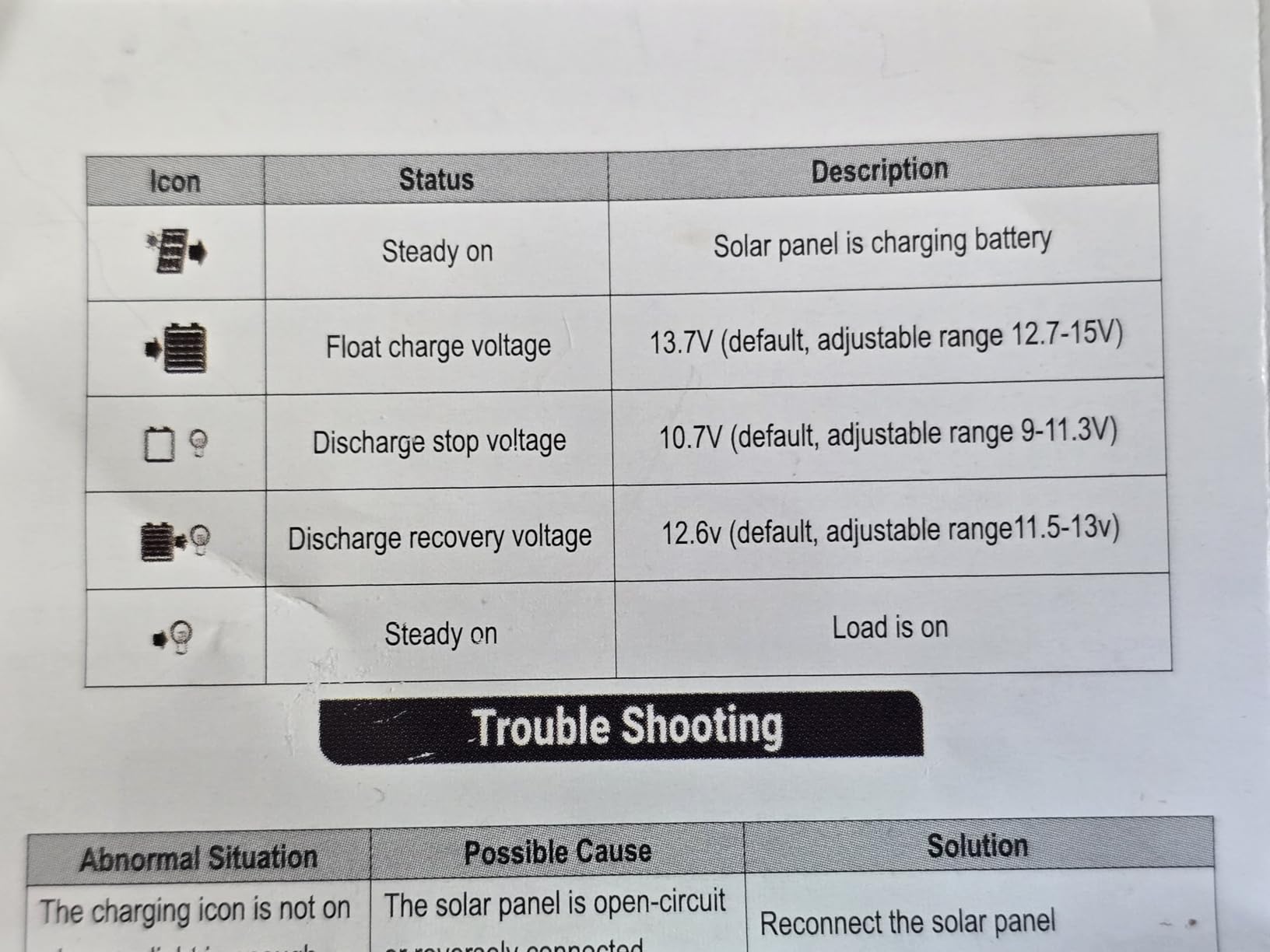
The short version: a charge controller is a regulator with a brain. It watches the voltage coming off the panels and the voltage on the battery, then decides how much current to push through. It runs that decision through charge stages. Bulk pushes current in hard until the battery reaches its absorption voltage. Absorption holds that voltage while current tapers. Float drops the target and holds a maintenance voltage. Equalization, on flooded and some AGM banks, raises voltage periodically to rebalance cells.
MPPT and PWM are two different ways of doing that job. A PWM controller simply chops the panel output to match the battery voltage. The panel sits near its optimal power point only when battery voltage and panel voltage happen to line up, so on a cold morning, in low light, or on a 12V system running a battery at 13.8V, a meaningful slice of the array’s potential output is thrown away as heat. An MPPT controller runs a DC-to-DC converter that can take a high panel voltage and low current and step it down to a lower voltage and higher current, which is exactly the conversion a forum user described as something controllers cannot do efficiently when they are only switching, not converting.
Practical rule of thumb: on a small, well-matched system, the gap between PWM and MPPT is modest. On a 12V bank with a 30V nominal panel, a high battery voltage, partial shading, or cold weather, MPPT pulls meaningfully more usable energy. Forum consensus treats PWM as acceptable for one or two small panels and MPPT as the default for anything larger, and our list reflects that split with three PWM models and seven MPPT units.
Two terms come up constantly and deserve a plain definition. PV input voltage, often labelled VOC in panel data sheets, is the highest voltage the controller will accept from the array, and series strings must stay under it even on the coldest morning of the year. Negative grounding means the controller’s reference terminal is tied to the battery negative rather than the positive, and it is the standard on RV and marine systems where metal panels and chassis paths can tie the two together; common negative and negative ground controllers are not the same part.
Lithium changes the profile too. A LiFePO4 pack wants a bulk stage that climbs, an absorption step that does not linger, and no equalization. A lead-acid bank wants a long absorption and periodic equalization. Controllers that support both usually expose a battery type selector or a user-defined lithium profile, and the ones that only support lead-acid will say so plainly rather than quietly. If your bank is lithium, that one checkbox eliminates half this list.
1. Renogy Rover 40A MPPT Charge Controller – The Best Overall Pick
Renogy Solar Charge Controller Rover 40A 12V24V Auto Parameter DC Input MPPT Charge Controllers for Solar Panels Adjustable LCD for Gel Sealed Flooded Lithium Battery
98% conversion, 99% tracking
12V/24V auto-detect
-40F to 149F operation
3-year warranty, 1.1 kg
Pros
- 98% conversion rate and 99% MPPT tracking efficiency
- Backlit LCD shows amps
- battery percentage
- amp-hour accumulation and voltage
- Dedicated load leads up to 20A DC protect the bank
- 12V and 24V auto-detection broadens wiring options
- Rugged aluminum build rated from -40F to 149F
Cons
- Bluetooth BT-2 module needs frequent replugging and resets
- State-of-charge reading can be inaccurate on mixed-capacity banks
- Terminals are very tight for large 8 AWG cable
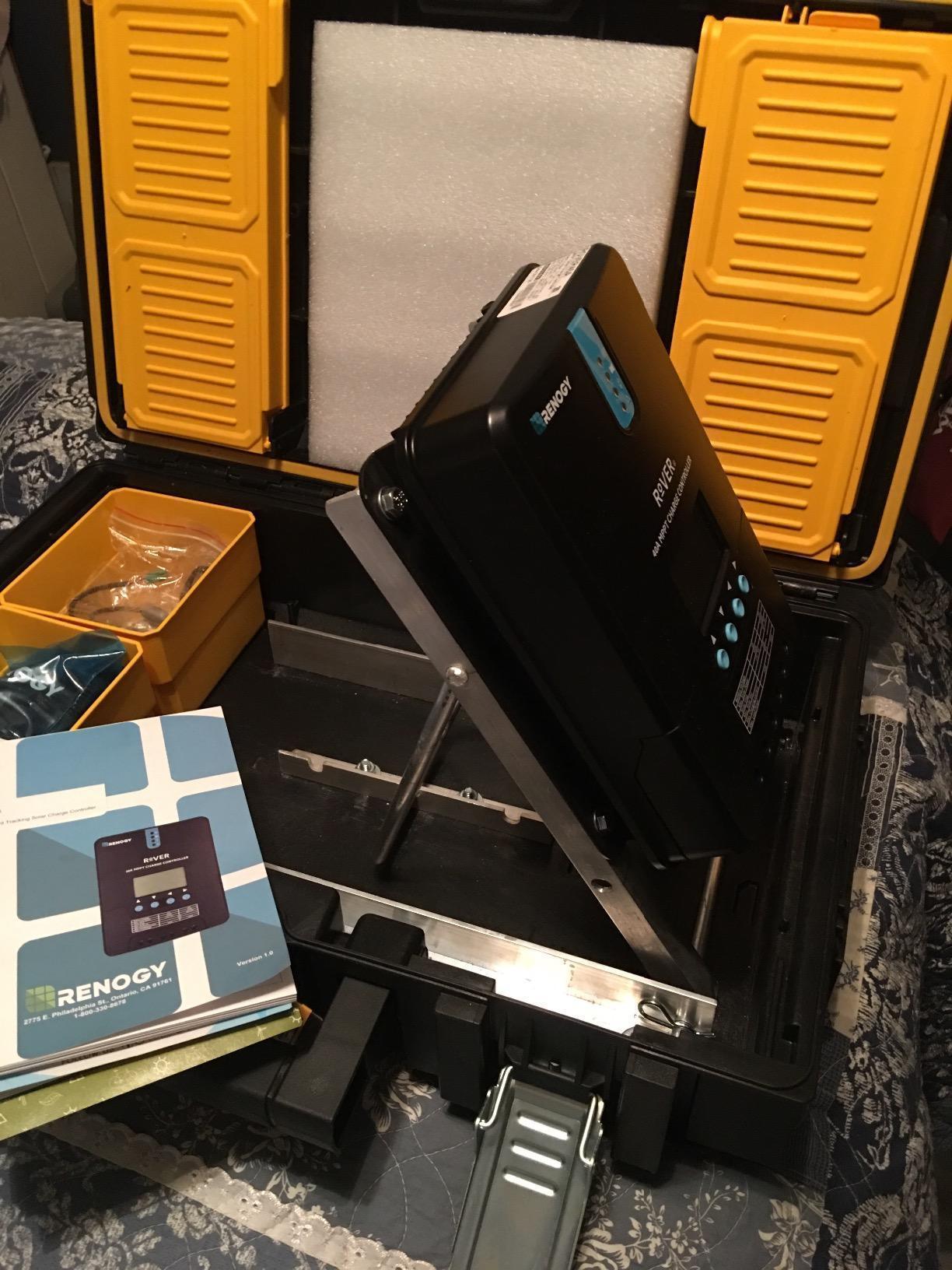
The Rover 40A is the controller we kept coming back to while working through this list. It is a 40 amp MPPT unit with a backlit LCD on the front, a remote temperature sensor in the box, and four mounting brackets, and it does the unglamorous work of sitting in a cabinet and charging correctly. The rated output is 40 amps with 12V/24V auto-detection, which covers a 400W array on a 12V bank with room to grow into a second panel string.
Owners consistently describe it as a rugged step up from entry-level PWM controllers, and the numbers back that framing. Tracking efficiency is 99% and conversion efficiency is 98%, and the stage logic is four-stage MPPT for lead-acid, dropping to two-stage for lithium so it does not hold a lithium bank at lead-acid absorption voltages.
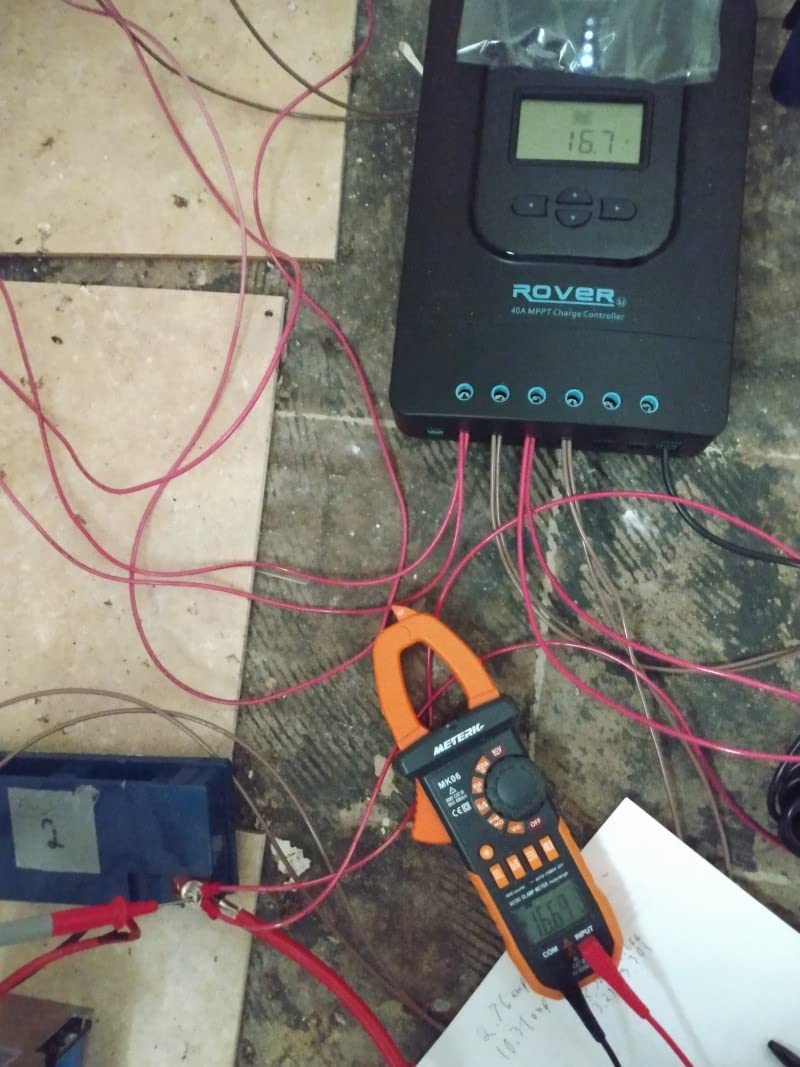
The details that matter in a real install are mostly positive. The backlit screen reads out charge current, battery percentage, accumulated amp-hours, and voltage, which is more information than most controllers in this class give you without buying a remote meter. Load leads rated up to 20A DC let the controller disconnect small loads before the bank goes deeply discharged, which is genuinely useful for a lighting circuit or a small device on an off-grid cabin.
Operating range is listed from -40F to 149F with a built-in low-temperature cutoff you can adjust from the app, and the protection list covers reverse polarity, overcharge, over-discharge, overload, short circuit, and reverse current. The enclosure is aluminum and the whole unit weighs 1.1 kg, which is a manageable size for a wall mount.
Does 40 amps cover your array, and is the Bluetooth module required?
A 40 amp controller handles roughly 400W of panels on a 12V bank and up to around 800W on a 24V system once you allow for conversion losses, so it covers most RV, van, and small cabin arrays with margin. The Bluetooth is a separate purchase: the BT-2 module talks to Renogy’s DC Home app over RS485, and the app stores about 30 days of history. If remote monitoring matters to you, budget for the module; if you are happy reading the LCD, the controller works fine on its own.
Warranty is three years for material and workmanship, and reviewers mention responsive technical support for configuration problems, though some report that support can take time to actually resolve an issue. If you want Bluetooth built into the box rather than added later, the Victron and the LiTime both ship with it.
Where the Rover falls short
Two complaints come up repeatedly. The BT-2 module is reported by some users to need frequent replugging and resetting, which is annoying in a vehicle where the controller is in a hidden compartment. And the state-of-charge percentage can read inaccurately, particularly when the bank mixes batteries of different capacities, because the algorithm is estimating rather than measuring.
Terminals are tight for large 8 AWG cable, so plan your crimps carefully and use a proper tool rather than forcing the screw. If accurate live data is your top priority and you are willing to pay for it, the Victron SmartSolar pairs cleanly and shows more detail per screen.
2. Depvko 100A MPPT Charge Controller with LCD – The High-Amperage Most Versatile
100A MPPT Solar Charge Controller with Auto Parameter LCD Display
100A MPPT output
12V/24V auto-recognition
Up to 99% efficiency
12-month warranty
Pros
- 100 amp MPPT output in a compact unit
- Simple plug-and-play 12V/24V auto-detection setup
- Readable LCD with real-time performance updates
- Dual USB output ports for powering small devices
- Delivers far more charge current than a stock 30A controller
Cons
- Small connector slots that barely accept 10 AWG wire
- LCD is thin on information and SOC estimate is only accurate when charging halts
- Needs weather protection
- not sealed for outdoor exposure
This is the odd one out in the roundup, and that is exactly why it is worth a look. You get a 100 amp MPPT controller with 12V/24V auto-recognition and a stated efficiency of up to 99%, at an outlay where most buyers expect to settle for 30A. Reviewers overwhelmingly describe the use case as a budget replacement: people swapping out a stock 30A controller and finding they get far more charge current for very little money.
Enclosure material is ABS plastic with a blue face and an LCD that updates with real-time performance figures. Protections are built in against overcharge, short circuit, and reverse polarity, and the warranty is 12 months with lifetime technical support listed.
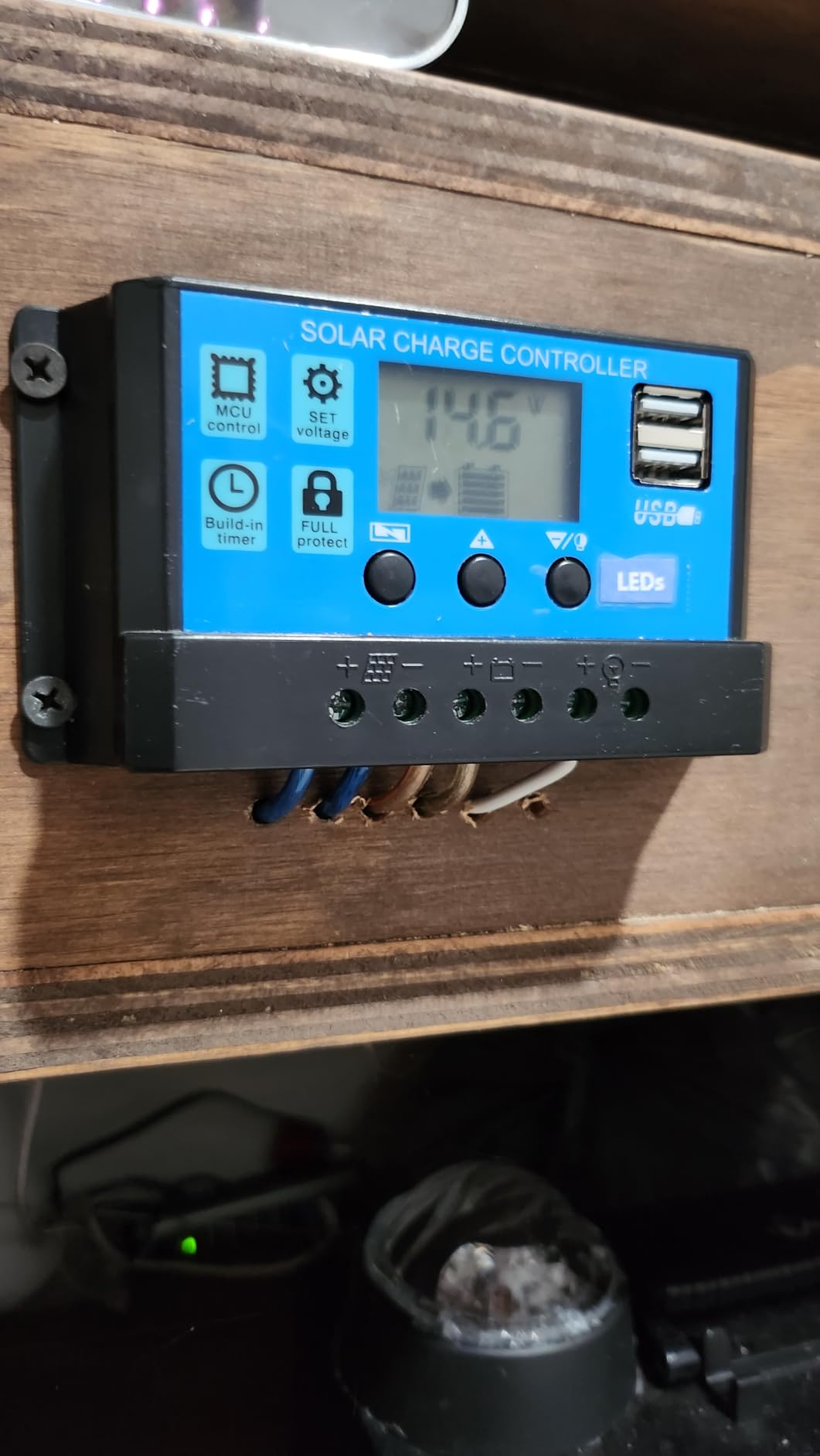
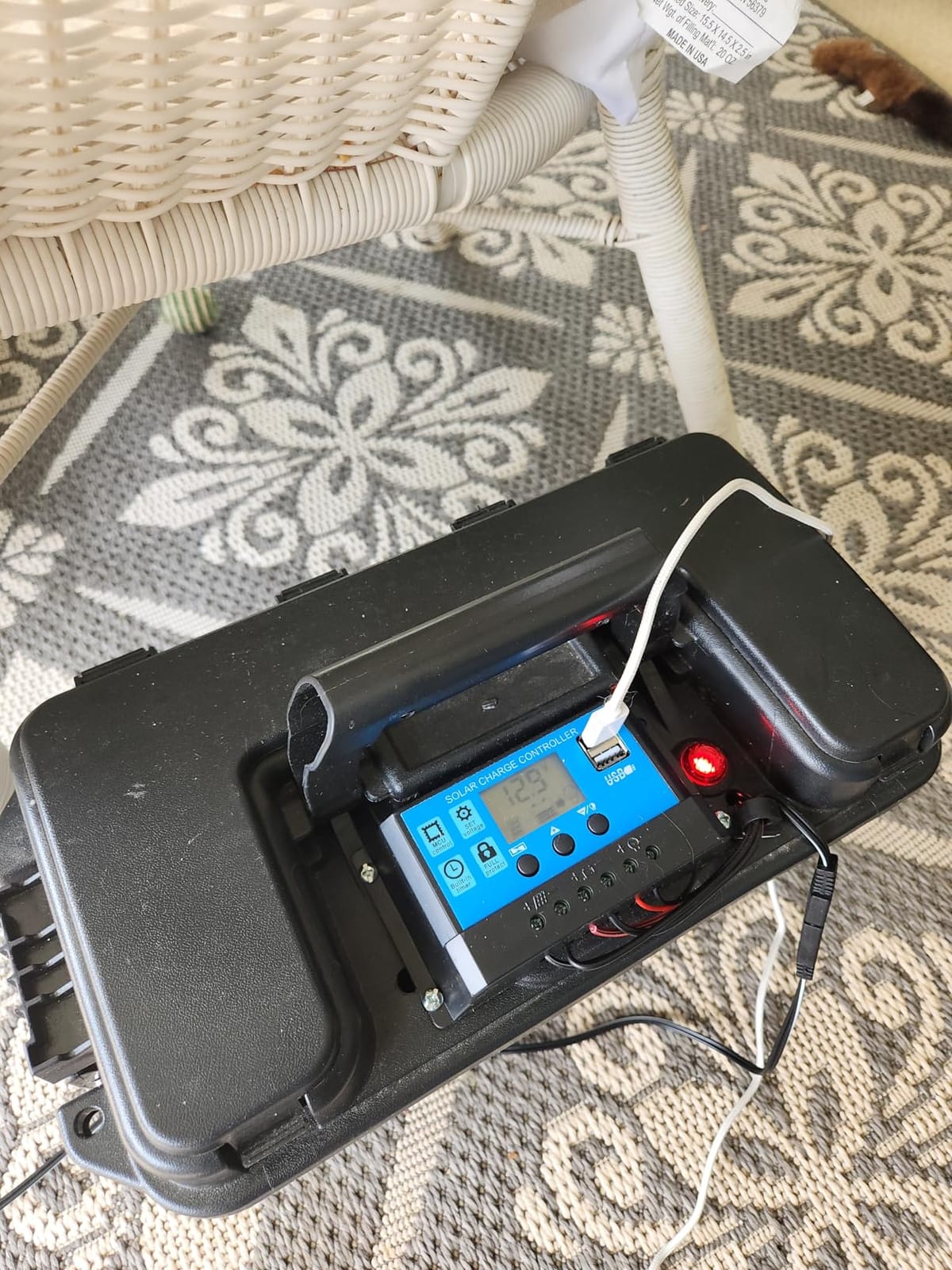
The dual USB output ports are the detail that surprises people. On a shed or a trailer, charging a phone or a small device straight off the controller is a convenience you would normally pay extra for. Installation is straightforward plug-and-play, with 12V/24V detection handled automatically.
What you give up is physical robustness. The connector slots are small and barely accept 10 AWG wire, with tiny set screws that are hard to tighten properly, and that combination is exactly where a high-current installation gets dangerous. The housing is plastic, so keep it inside a rated enclosure rather than on an exposed bulkhead.
Is a 100 amp controller sensible for a small system?
Over-sizing a controller is not harmful in itself. If your array is small, the controller simply will not be asked to pass more current than the panels can produce, so a 100A unit on a 200W array works fine and leaves room to add panels later. The cost is the purchase outlay, the space it takes, and the fact that the terminals are the weak point on this model.
Note that the SOC estimate is only accurate once charging has halted, so treat the percentage on the LCD as a rough indicator rather than a number to plan around. The instructions are also disjointed and initially reference lead-acid only, which is a hint to check lithium support with the manufacturer before committing.
Who should skip it
Skip this controller if your install is in a marine or exposed environment, or if you are running thick battery cable. Some buyers report melted cables or slow battery drain on controllers they bought, and the small terminals make that a plausible failure path. For an RV interior or a shed with a modest panel, it is a capable budget unit; for anything permanent, put your money into terminal quality instead.
A few owners also report the LCD is thin on information compared with a controller in this amperage class. If you want a fuller screen, the HQST 100A further down the list gives you far more data, Bluetooth, and proper wire sockets for a comparable step up in build.
3. Victron Energy SmartSolar MPPT 100/50 – The Most Compact
Victron Energy SmartSolar MPPT Solar Charge Controller 100V, 50A, 12/24V
100V max PV input
50A charge current
Built-in Bluetooth
All-metal case, 1.5 kg
Pros
- 4.6 stars with 86% of reviews at five stars
- All-metal case with bottom heat sink dissipates heat well in 12V systems
- VictronConnect app gives real-time data
- 30-day history and battery presets
- Can wake deeply discharged LiFePO4 batteries
- Compact footprint under half the size of competing MPPT units
Cons
- Small cable terminals that will not accept 4 AWG battery cable
- 100V PV ceiling limits you to two 33V panels in series
- Pair Bluetooth up close for a reliable connection
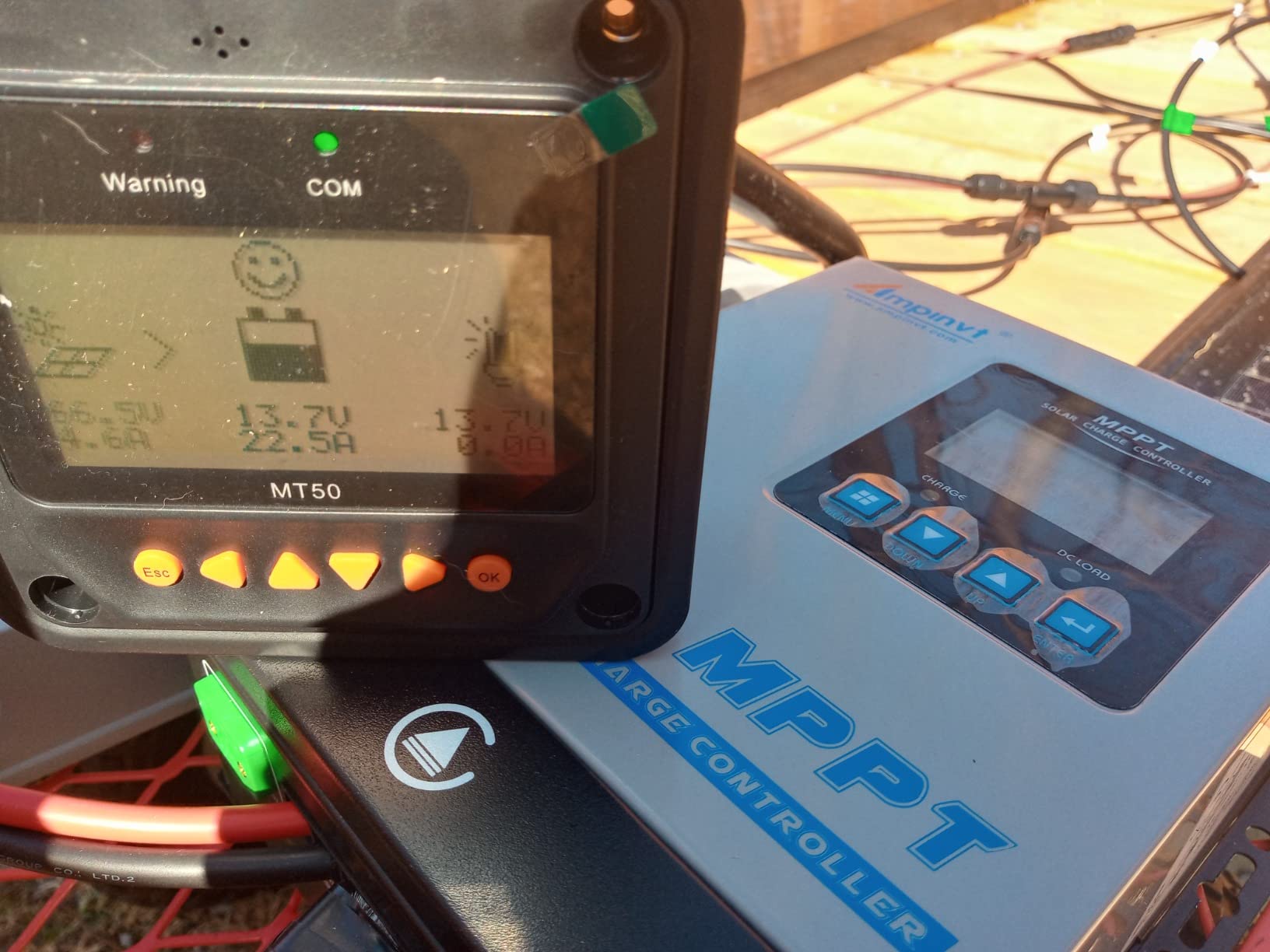
The Victron SmartSolar 100/50 holds the highest rating in this roundup, sitting at 4.6 stars across more than two thousand reviews with 86% of those ratings at five stars. It delivers 50 amps of charge current with a 100 volt maximum PV input, and it auto-handles 12V and 24V systems, which makes it the natural fit for a serious off-grid build or a boat that sees a lot of partial sun.
What stands out on inspection is the enclosure. It is an all-metal case with a bottom heat sink, and reviewers repeatedly single out how cool it runs in a 12V system compared to plastic-bodied competitors. That matters more than it sounds, because heat is what limits sustained output and what ages electrolytic components.
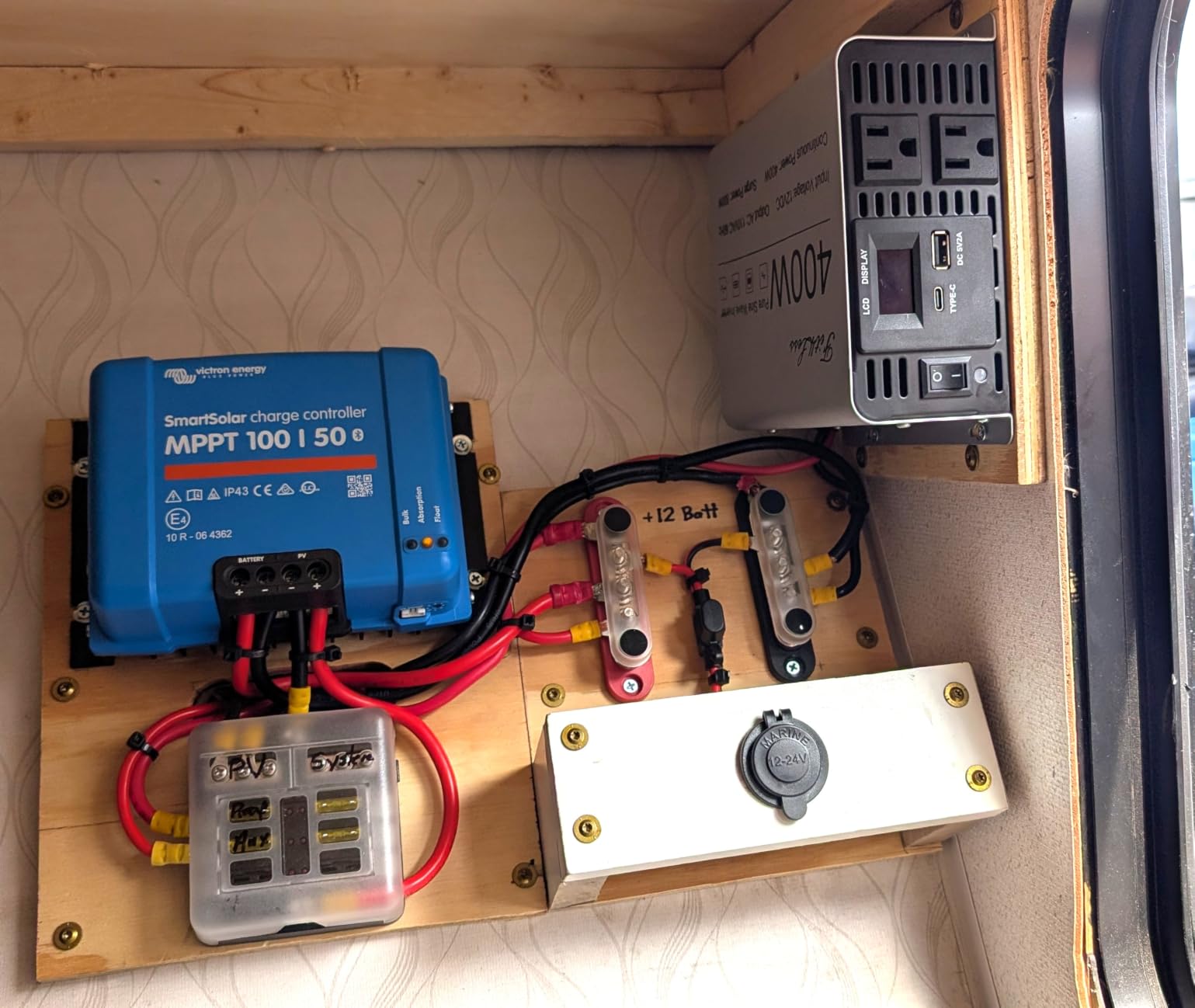
Bluetooth is built in, and the VictronConnect app handles real-time data, 30 days of history, battery presets, and firmware updates without a separate dongle. Multiple SmartSolar units can synchronize and behave as one, so expanding a system later does not mean fighting two controllers for the same battery.
The intelligent load output is another quiet feature. It disconnects loads automatically at a configurable low battery voltage, which is a real benefit if you are running lights or a small appliance off the controller and want the bank protected at the end of a cloudy stretch. Two variants exist, 100V/30A and 100V/50A.
How much solar can a 50 amp controller actually take?
Fifty amps on a 12V bank supports roughly 500W of panels, and on 24V about 1000W, with the usual allowance for conversion losses. The 100V PV ceiling is the tighter constraint for a lot of buyers. It is enough for two 33V residential panels in series, but if you want to run three or more in series to cut current and cable size, you need a controller with a higher PV input ceiling, such as the HQST in this list at 150V.
Compactness is a genuine advantage. At 7.32 by 5.12 by 2.76 inches and 1.5 kg, it takes up noticeably less space than the plastic controllers here, which matters on a boat bulkhead or inside a crowded RV electrical bay. Keep in mind that the cable terminals are small and will not accept 4 AWG battery cable, so plan your lugs accordingly.
What you trade for the premium
The honest drawback is the outlay, and US support structure. Forum users consistently report the Victron as rock solid with no regrets after expanding systems, and one Geekzone user specifically cited performance when they scaled up, but direct support in the US tends to route through dealers rather than a direct line. Factor that in if you are installing far from dealer coverage.
Bluetooth also needs to be paired up close to establish a reliable connection, and the 100V ceiling limits series string options. If your panels are already in hand and you want a higher PV input ceiling plus built-in monitoring, the HQST further down covers both.
4. Renogy Wanderer Li 30A PWM Controller – The Simple 12V Workhorse
Renogy Wanderer Li 30A PWM Solar Charge Controller 12V for Solar Panels
12V PWM, 30A rated
IP32 waterproof casing
4-stage lead-acid and lithium
DIN rail or wall mount
Pros
- Compact 30 amp PWM regulator for small 12V arrays
- Four-stage charging for lithium
- AGM
- gel and flooded banks
- Holds charge voltage longer and handles cloudy conditions better than cheap controllers
- Bright LED indicators readable in direct sunlight
- Compact enough for tight RV and marine compartments
Cons
- No built-in Bluetooth
- BT-1 module sold separately
- No USB or load output ports
- Instruction pamphlet does not explain the LED flash patterns
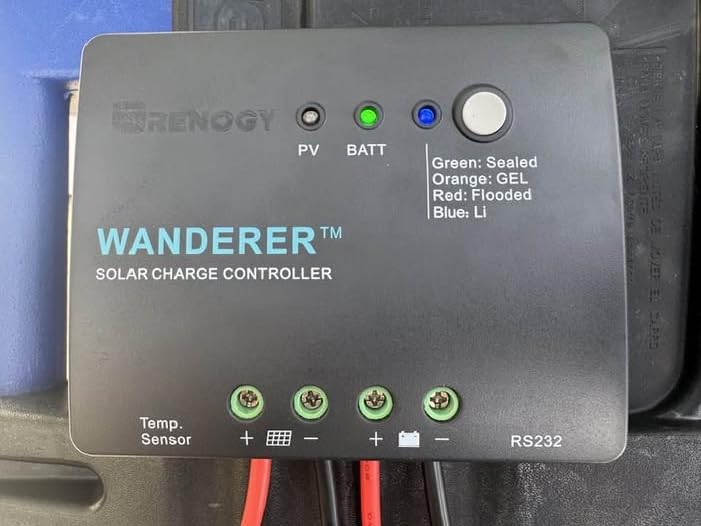
The Wanderer Li 30A is the one we would put on a shed wall next to a single 100W panel, and it carries more than two thousand reviews from owners. It is a 12V PWM regulator with a 30 amp rating, roughly 4.8 ounces, and small enough to disappear into a junction box. For a small array on a small bank, the efficiency penalty of PWM is not going to cost you much in practice.
Owners consistently treat it as a solid step up from ultra-cheap generic controllers. They praise the terminal design most, and they praise the charge behaviour: several reviewers note it holds charge voltage longer and deals with cloudy conditions better than cheap units, and one notes it keeps charging through low-voltage events without needing a reset.
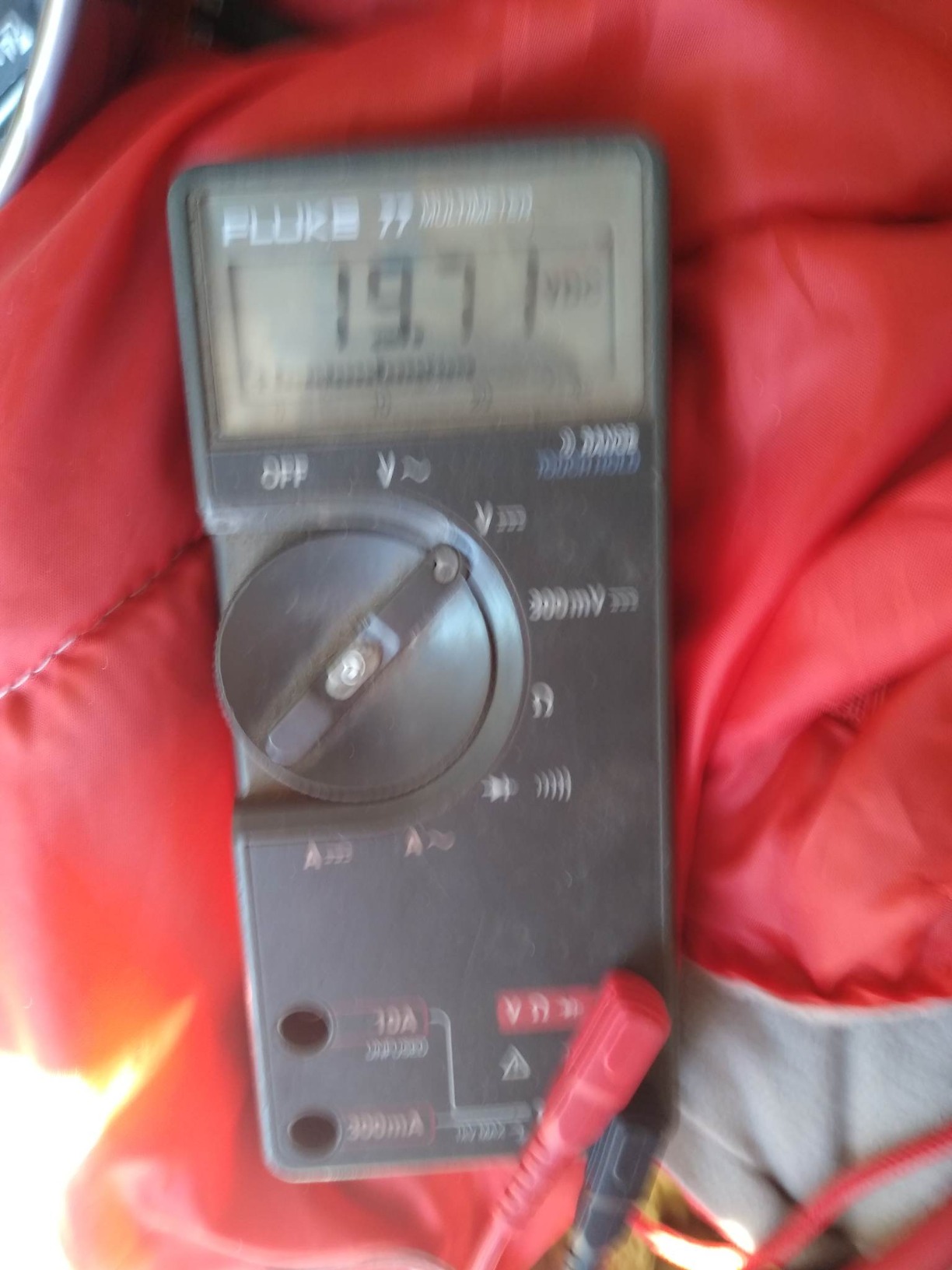
The charge profile is four-stage PWM covering bulk, boost, float, and automatic equalization, and it optimises for lithium, AGM, gel, and flooded batteries. That lithium support is the reason to pick this over a generic PWM box, because most entry-level regulators silently assume lead-acid and will overcharge a LiFePO4 pack.
The casing is rated IP32 for waterproofing and corrosion resistance and mounts on a DIN rail or a wall, and the LED indicators are bright enough to read in direct sun, which is more than several LCD-based competitors manage. Temperature compensation from -4F to 140F is available with the optional BT-1 module.
Does PWM hurt on a small 12V system?
On a single panel at 30W or 100W, the gap between PWM and MPPT is small in absolute terms, because you are only moving a few amps. PWM becomes painful when the array is large, the battery sits at a high float voltage, or light is poor, and none of those describe a small shed panel. If you have never heard float creep complaints on your system, a PWM unit will not introduce them.
The more common regret with this controller is feature access. There is no Bluetooth and no USB, and monitoring is a set of LEDs rather than a screen, so if you want to check state of charge remotely you will need the BT-1 module and the DC Home app. The pamphlet is black and white and does not explain the LED flash patterns, so expect a few minutes of figuring it out.
Where the PWM trade-off stops being worth it
Step up once your panel array passes roughly 200W, once you move to a 24V system, or once you start caring about cold morning output. In those cases the 20 to 30 percent energy gap between PWM and MPPT becomes the dominant factor, and a controller like the EPEVER Tracer or the BougeRV 40A will pay for itself quickly in recovered energy.
Grub screws can also be awkward to reposition if a wire is seated wrong, and the housing is a little bulky for a very small enclosure. If you want lithium support with a screen and a Bluetooth app at a similar outlay, the BougeRV Li 30A further down covers the same ground with a backlit display.
5. HQST 100A MPPT Controller with Bluetooth and LCD – Best for High-Voltage Strings
HQST 100A MPPT Charge Controller, 12V/24V/36V/48V Auto, Bluetooth & LCD
150V max PV input
12V, 24V, 36V, 48V support
Built-in Bluetooth
99% tracking efficiency
Pros
- Fast broad MPPT tracking across arrays with multiple local power maxima
- Integrated Bluetooth is rare in this class and works at roughly 30 feet
- Large sturdy wire sockets that accept thick cable
- 150V PV input allows six 12V panels in series
- Substantial heat sink keeps temperatures well regulated
Cons
- Default LiFePO4 charge parameters limit output to about two-thirds of available panel current
- App history page is buggy and skips days
- App handles only one controller at a time
- Reported battery voltage reads higher than an external BMS
The HQST 100A covers the widest range of system voltages in this roundup, and it is the one to look at if you are running a long series string. Maximum PV input voltage is 150V, which is enough for six 12V panels in series, and the battery side supports 12V, 24V, 36V, and 48V systems automatically, a combination you rarely see in one controller.
MPPT performance is where technical reviewers rate it highly. Tracking efficiency is 99% and peak conversion efficiency 98.7%, and reviewers note the algorithm handles difficult arrays with multiple local power maxima without getting stuck, which is the classic failure mode on a shaded rooftop or a cabin with a chimney in the way.
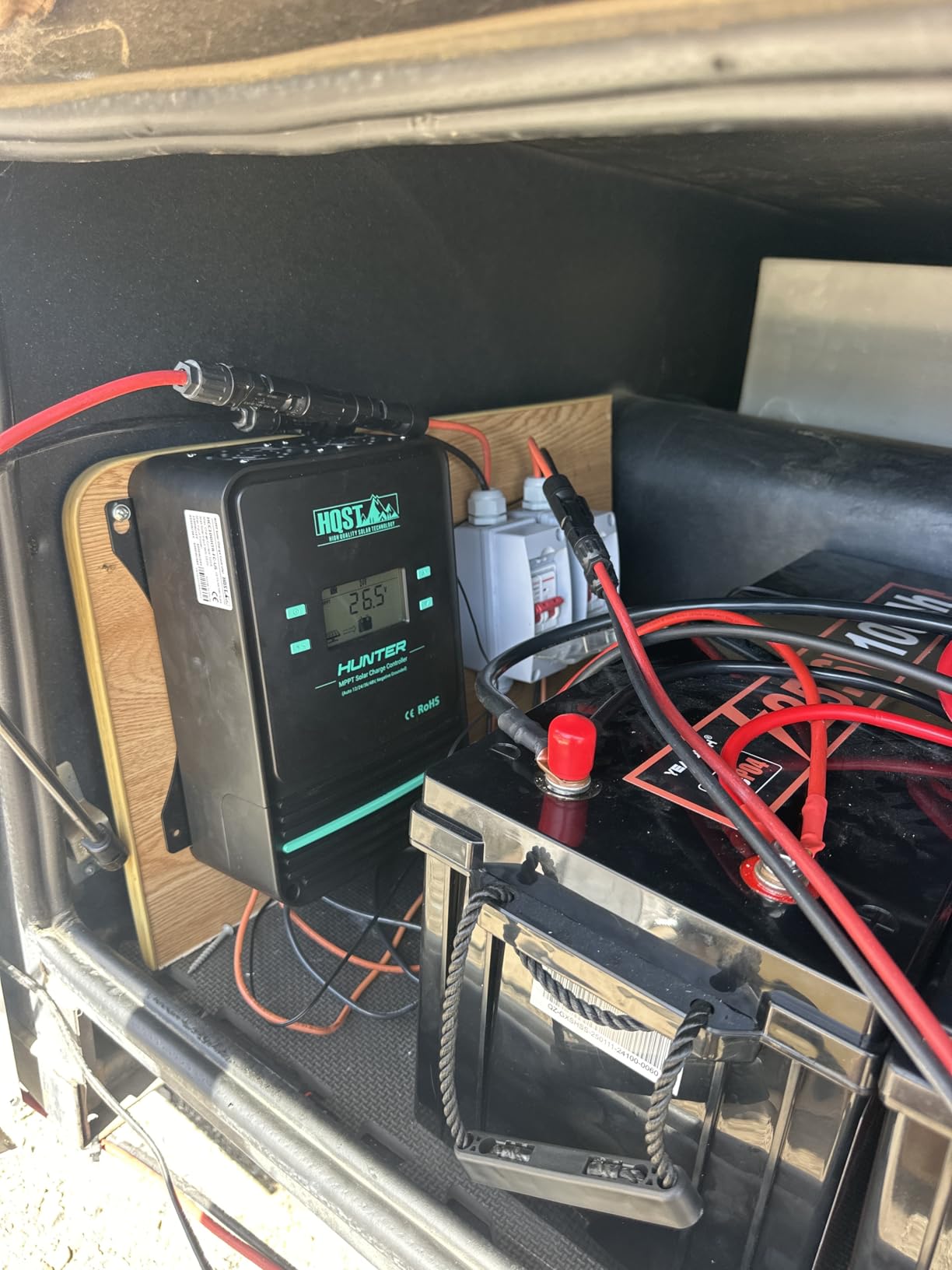
Built-in Bluetooth is the standout feature here, and it is genuinely part of the unit rather than a dongle. The app connects at an effective range of about 33 feet, stores 300 days of historical data, and allows parameter adjustment. Two cooling fans activate above high power or 113F, backed by a substantial heat sink, and the unit weighs 2.8 kg.
For expansion, up to nine M4880F or M48100F controllers can be charged in parallel on one battery bank, though the interconnection cables are not included and you will need to source them. The design is negative-grounded with 10 built-in protections, which is the correct convention for RV and marine installs.
Why does the 150V input ceiling matter?
Putting panels in series raises voltage and lowers current, and lower current means thinner cable and smaller fusing for the same power. Six 12V panels in series against a 150V ceiling gets you most of that benefit, which is why this controller suits a larger fixed array. If you only have two panels, a 100V controller is all you need and the extra ceiling is dead weight.
Two things to fix on day one. The default LiFePO4 charge parameters limit output to roughly two-thirds of the available panel current unless you raise them manually, and the reported battery voltage reads noticeably higher than an external BMS reading, so calibrate your expectations against a real meter. The app history page is also buggy and skips days, and it only handles one controller at a time, unlike the multi-device view on Victron’s app.
Is the 100A rating realistic for a single array?
One hundred amps is a lot of current, and most residential arrays will never push a 100 amp controller to its limit. Think of it as headroom: a 100A unit on a 600W to 800W array keeps the controller out of saturation and leaves an easy upgrade path. If you are hard against a wall, the 30A models here do the same job with a smaller footprint and less idle hardware.
Two more practical notes. Bluetooth requires mobile location services to be enabled on your phone before it will connect, which catches people out. And there is no programming video or clear setup walkthrough supplied, so allow time to read the manual rather than assuming it is plug-and-play.
6. Rolokit 30A PWM Controller with Dual USB – Best for Lead-Acid With USB Loads
30A PWM Solar Charge Controller, 12V 24V Dual USB Solar Panel Battery Intelligent Regulator with LCD Display, Auto Parameter Adjustable, Timer Setting, Multiple Load Control Modes
30A PWM output
12V/24V auto compatibility
Dual 5V 3A USB outputs
Adjustable float and cutoff
Pros
- Compact 30 amp PWM regulator with adjustable parameters
- Built-in industrial microcontroller memorises settings when the battery is depleted
- Dual 5V 3A USB outputs are a useful addition at this tier
- LCD allows mode switching and parameter configuration
- 12-month quality guarantee
Cons
- Not compatible with lithium or LiFePO4 batteries
- PWM topology is considerably less efficient than MPPT in low light
- Lead-acid-only chemistry rules out most modern lithium systems
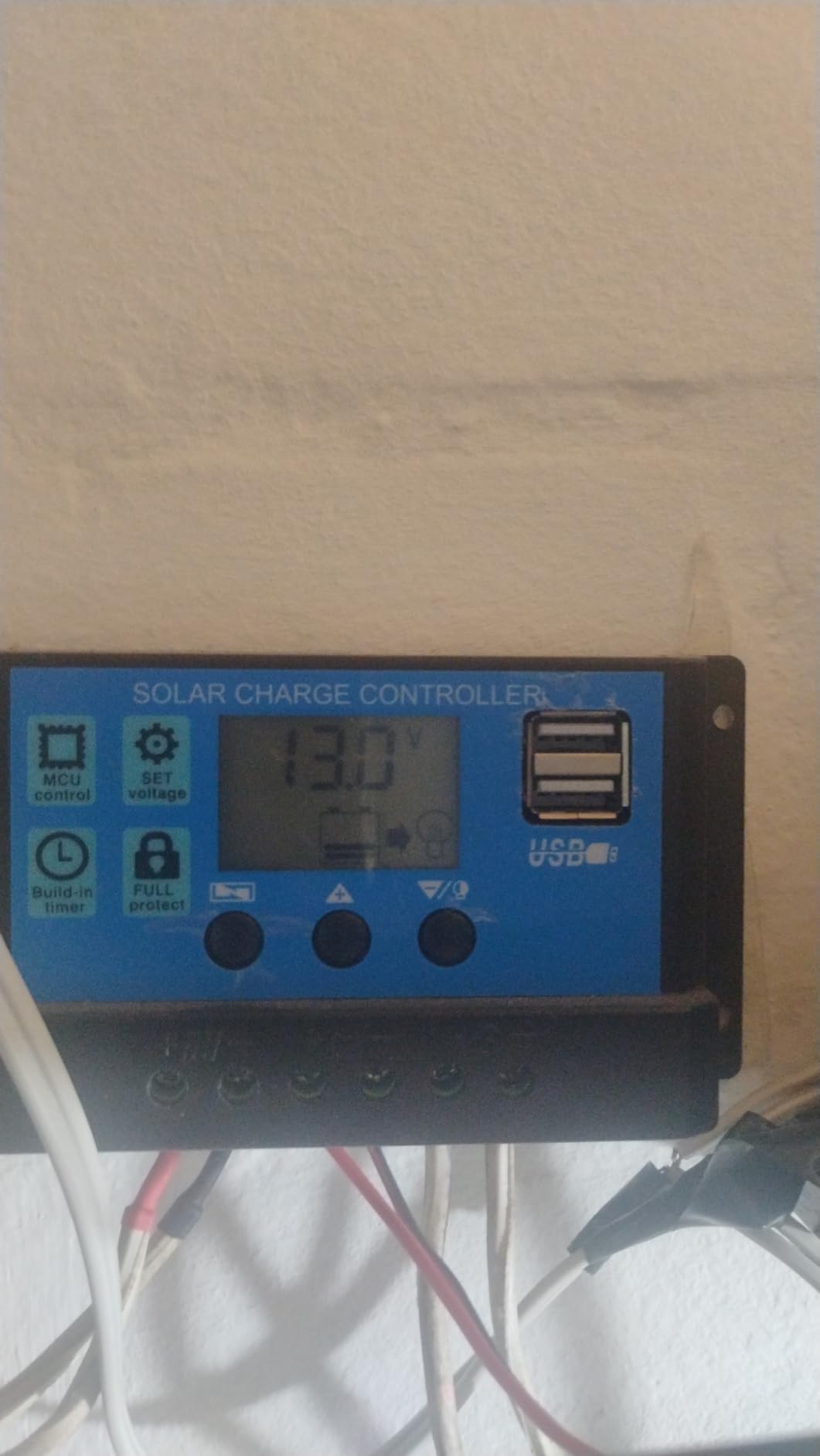
The Rolokit is the simplest controller here, and the reason to include it is the pair of USB ports. Two 5V 3A outputs on the face means a shed controller can charge a phone and a small device directly without a separate USB adapter drawing from the battery. If that convenience matters and your bank is lead-acid, this does the job as a no-frills regulator.
It is a 30 amp PWM controller with automatic 12V and 24V compatibility, an LCD for mode switching and parameter setup, and adjustable float, reconnect, and stop-discharge voltages. Protections cover overcurrent, short circuit, reverse connection, and open circuit, all with automatic recovery.
One detail stands out: the built-in industrial microcontroller, which memorises your set parameters when the battery goes flat. On cheap controllers, a deep discharge often wipes your settings and leaves you reconfiguring after every long cloudy stretch. This one does not.
Installation follows a sensible order, battery first, then panel, then load, and it carries a 12-month quality guarantee. Weight is a light 0.14 kg, and the enclosure is a simple blue plastic box.
Is the lead-acid only limit a deal-breaker?
For a lot of people, yes. The controller supports open, AGM, and gel flooded chemistries and nothing else, so a LiFePO4 or ternary lithium bank is simply out of scope. Given how quickly lithium has taken over RV and van builds, that restriction removes this controller from consideration for most new installations, even though the controller itself is competent at what it does.
The other issue is the PWM topology itself. In low light, a PWM regulator sheds a meaningful slice of available energy compared with MPPT, so if your array is undersized to begin with, adding an inefficient controller makes the shortfall worse. At roughly 200W or more, that gap becomes large enough to change your battery chemistry decisions.
Where this one still makes sense
It makes sense for an older lead-acid bank that you are maintaining rather than upgrading, a small array where energy yield is not the priority, or a build where USB outputs from the controller save you a separate accessory.
One 30A PWM alternative worth knowing about is the Renogy Wanderer Li, which adds a broader battery type menu and a more substantial terminal design. If lithium is not in your future, keep this one on the shortlist as a no-frills regulator.
7. BougeRV Li 30A PWM Controller – Best Lithium Support on a Budget
BougeRV Li 30A PWM Solar Charge Controller 12V 24V with Backlit Display
30A PWM, 12V/24V
55V max PV input
LFP, Li and LTO profiles
Backlit LCD
Pros
- Wide lithium support including LFP
- ternary Li and LTO with a jumpstart function
- Backlit display cycles PV input current and battery voltage
- Bluetooth app connects from about 50 feet
- Three pairs of spade terminals included
- Good value for a PWM unit with this feature set
Cons
- Terminals barely accept 10 AWG wire
- Runs extremely hot even with only a 100W panel
- App shows ads and limited real-time data
- No load connections
- so load control and draw monitoring are unavailable
The BougeRV Li is the most direct way on this list to get a controller that genuinely understands lithium. It has dedicated on-screen icons for LFP, ternary Li, and LTO chemistries rather than a single lithium setting, plus a jumpstart function for over-discharged packs. On a van conversion or a portable power station, that is the feature that stops a controller from being a dead accessory.
It is a 30 amp PWM unit covering 12V and 24V systems, rated for 55V maximum PV input and handling up to 4500W of PV on a 12V system or 900W on a 24V system. The backlit LCD cycles PV input current and battery voltage every three seconds and dims to 50 percent when idle.
The Bluetooth app connects from about 50 feet, which is longer than most competitors reach, and three pairs of spade terminals are included so you can crimp properly instead of relying on bare wire under a screw. Dimensions are 5.92 by 3.95 by 1.92 inches.
Owners like the broad lithium compatibility and the readability of the display in dim conditions, which matters when you are checking state in a garage or a dark camper. Several buyers report it as a capable PWM unit for its feature set.
How should you handle the heat and the terminals?
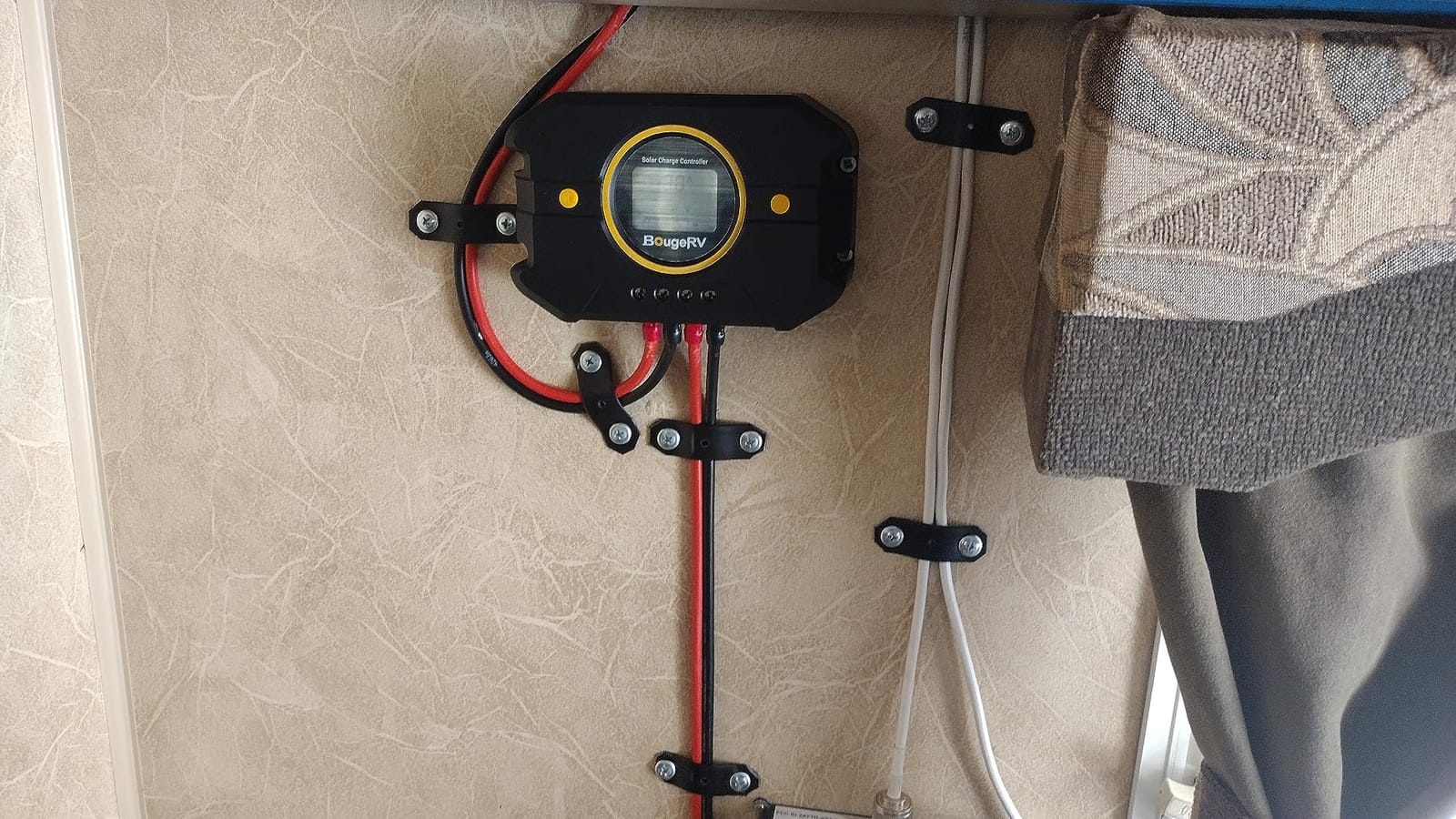
Heat is the main complaint, and it is worth planning around. Multiple owners report the unit running extremely hot, over 130F, even with only a 100W panel attached, which tells you the enclosure needs airflow regardless of how small the array is. Mount it somewhere with air moving around it, and do not bury it in a fully sealed box.
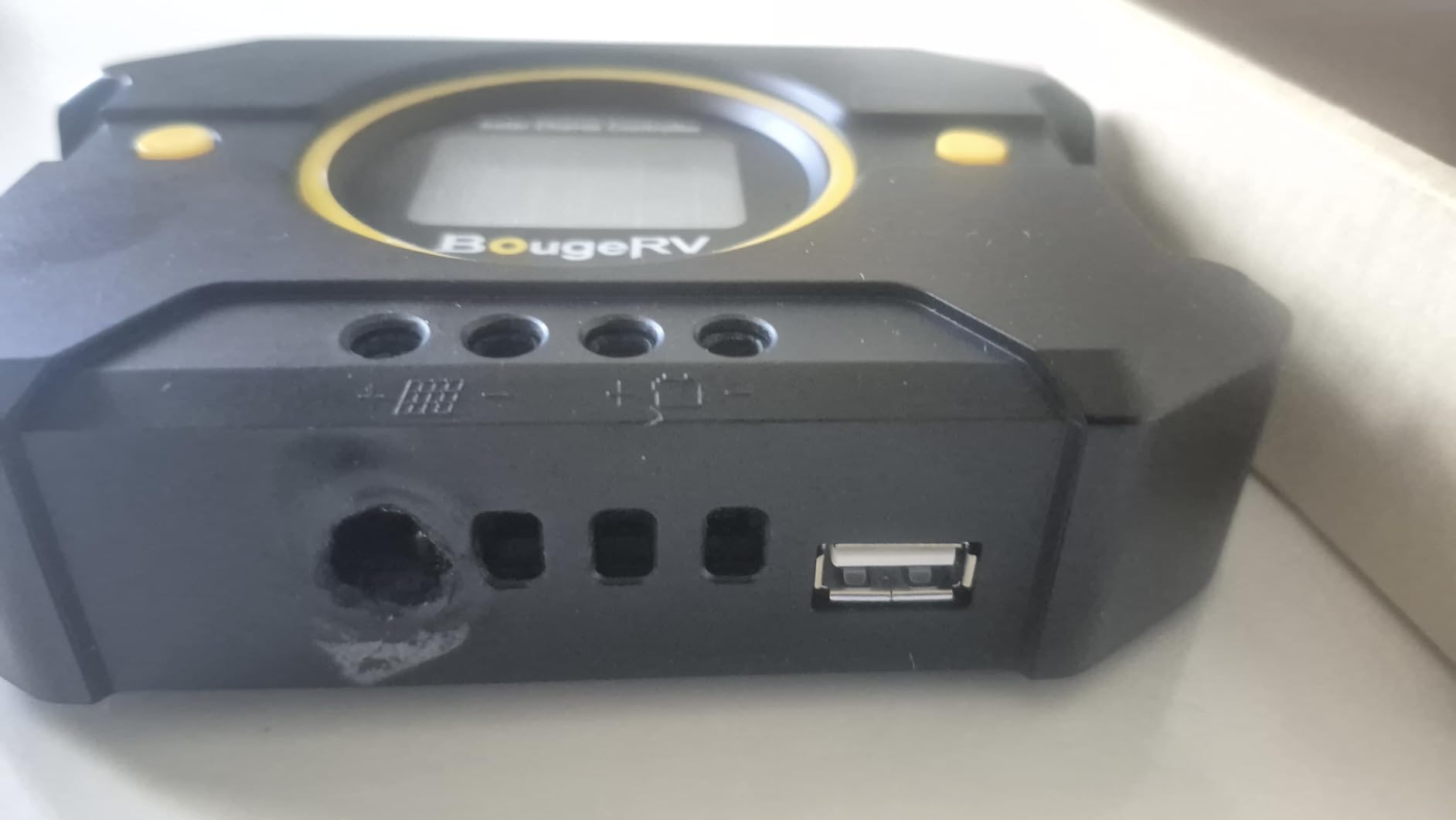
The terminals barely accept 10 AWG wire, which is thin for a controller rated at 30 amps. Buy the right lugs for your cable before you start, and follow the battery-first connection order. The app is more of a sales tool than a monitoring tool, showing ads and limited real-time data, with voltage readings that sometimes disagree with the LCD, so trust the screen over the phone.
Is PWM the right technology for a lithium system?
It works, and the chemistry handling is better than most, but you are leaving energy on the table every day. A PWM regulator runs at roughly 70 to 80 percent efficiency against 98 percent or better for a comparable MPPT unit, so on a lithium bank that you are trying to fill quickly on short winter days, the gap is felt. There are also no load connections, so load control and draw monitoring are unavailable.
One reviewer also reports a manual diagram showing cooling fins the 30A unit does not have, and a few controllers stopping charging or throwing low-voltage error codes after a couple of months. If you want the lithium profile without the efficiency penalty, the BougeRV 40A MPPT later in this list is the direct upgrade path.
8. EPEVER Tracer 30A MPPT Controller – The Best Value MPPT
EPEVER MPPT Solar Charge Controller 30A 12V 24V Auto Max PV 100V
30A MPPT, 12V/24V auto
100V max PV, 390W at 12V
99.5% tracking efficiency
RS485 Modbus bus
Pros
- Full chemistry menu usually reserved for higher tiers
- Very large connectors that easily accept 4 AWG cable
- Handles LiFePO4
- ternary Li
- AGM
- gel and flooded plus user-defined lithium
- Multiple load work modes with full-load operation
- Heaviest and most thermally robust MPPT unit in side-by-side testing
Cons
- Pinch-style screw connectors give less contact than clamp-style terminals
- Largest and heaviest housing in its class
- Bluetooth monitoring requires an add-on adapter rather than being built in
It is the controller we would tell someone to buy if they want MPPT quality without paying a premium for the badge. Independent comparative testing against other MPPT units found it performs comparably in cloudy and shaded conditions, with the largest connector openings of the group, which is exactly the balance you want when terminals matter this much.
It runs 30 amps with 12V/24V auto voltage recognition, takes up to 100V of PV input, and handles 390W of panel power at 12V or 780W at 24V. Tracking efficiency is above 99.5% and maximum DC/DC conversion efficiency is 98%, and the design uses common negative grounding, which is what you want in an RV or boat.
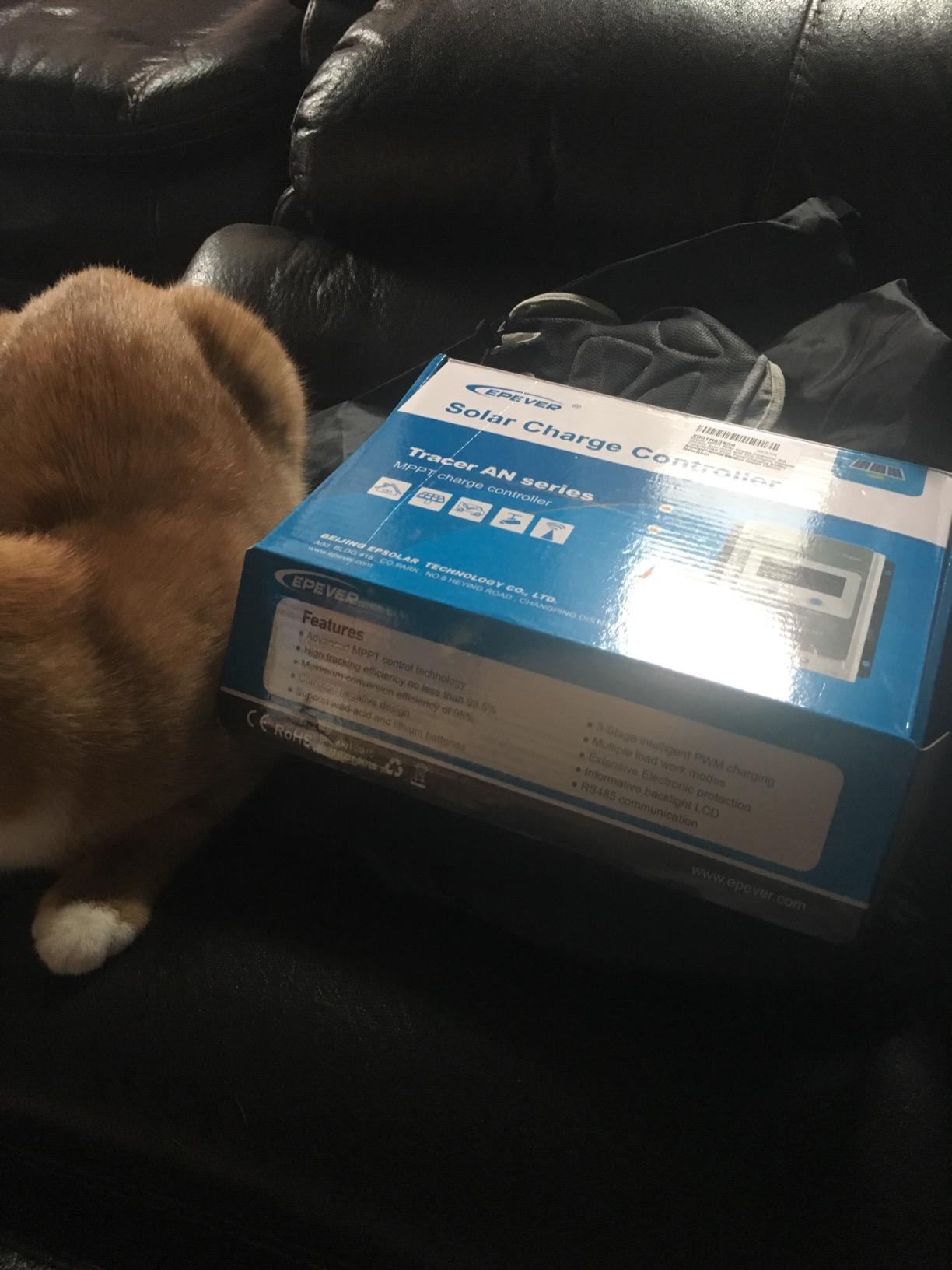
Battery chemistry support is where it outclasses most of this list. It handles gel, AGM, flooded, sealed, LiFePO4 at 4s for 12V and 8s for 24V, and Li(NiCoMn)O2, plus a user-defined lithium profile. Battery temperature compensation, real-time energy statistics, and overheating power reduction are all included, and a temperature sensor unit comes in the box.
The connectors are the practical headline. Reviewers single out how easily they accept 4 AWG cable, which is cable the Victron in this roundup will not take, in side-by-side testing this controller was the heaviest and most thermally robust of the MPPT controllers compared, with no capacity drop at full load across multiple load work modes.
Is monitoring included or an extra purchase?
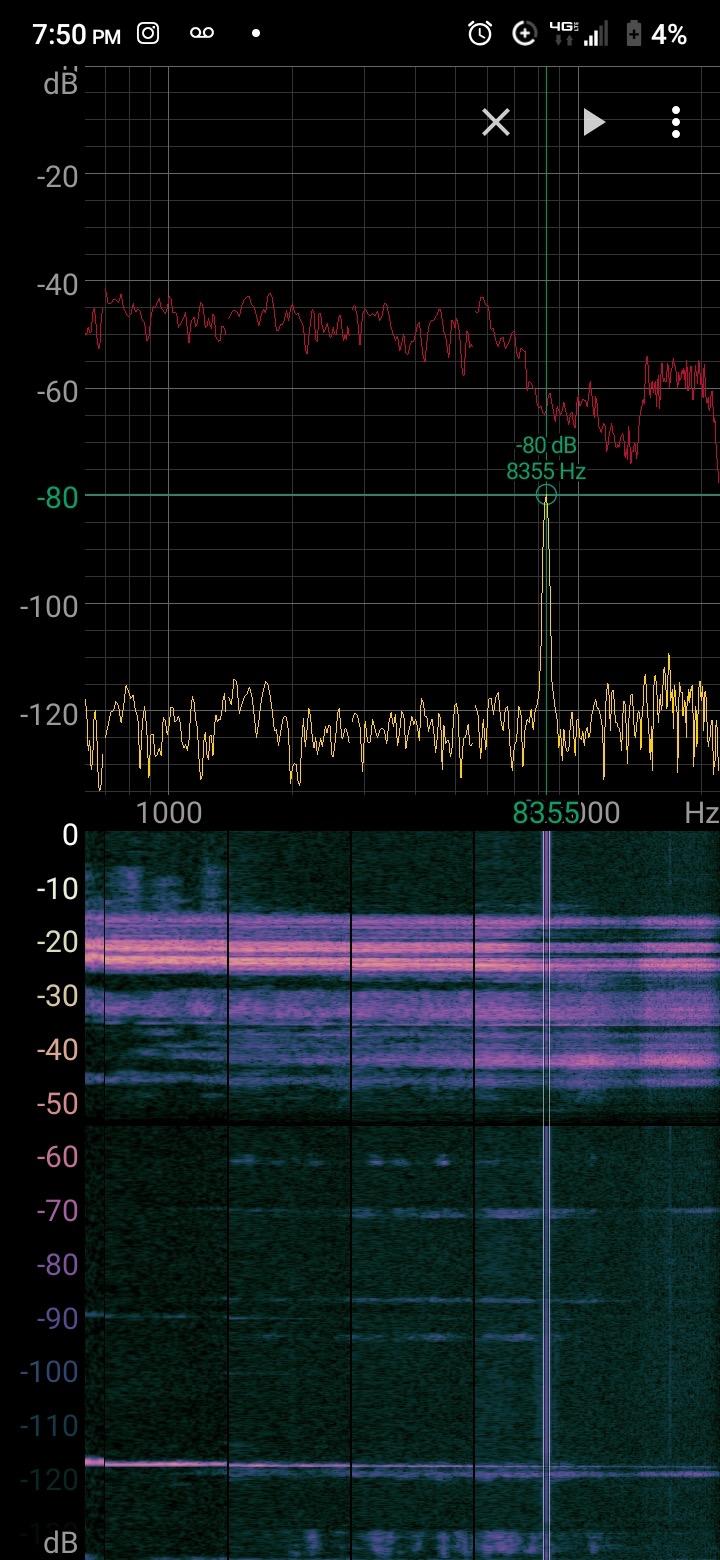
Monitoring is an extra purchase, and that is the main thing to plan for. Communication runs over RS485 with the Modbus protocol, and the actual hardware is a choice you make: an MT50 or MT52 remote meter, a WiFi adapter, a BLE adapter, the eLOG01, or a USB-RS485 cable. If you want phone monitoring, the Victron and the HQST both include Bluetooth in the box and skip this step entirely.
It is worth checking whether an accessory is available for your install before you commit, because the Tracer platform is also sold by several other brands under different labels. One competitor page we reviewed notes that SolarEpic-branded 40A controllers are built on the same TracerAN platform, which means you may be able to source support or manuals from a different brand. If you are comfortable with a remote meter on a bulkhead rather than a phone app, this is a perfectly good way to run the system.
What are you giving up versus the premium tier?
Two things. The connectors are pinch-style screws, which provide less contact and holding force than clamp-style terminals, so torque matters more here, and the body is the largest and heaviest housing in its class at 1.26 kg and nearly nine inches long, so you need real mounting space. Some users also report fan noise.
In exchange you get a full chemistry menu, a real temperature sensor, 4 AWG terminals, and MPPT efficiency at a level that matches controllers several tiers above it. If your priority list is efficiency, terminal size, and battery support, this is the one to buy.
9. BougeRV 40A MPPT Controller with Low-Temperature Cut-Off – The Camper Van Choice
BougeRV MPPT Solar Charge Controller 40A, w/ Low-Temp Cut-Off, APP Control, Backlit LCD, 40 Amp Solar Panel Regulator 12V/24V for LiFePO4, SLD, Gel, FLD, AGM Battery, RV, Marine, Upgraded
40A MPPT, 12V/24V
600W at 12V, 1200W at 24V
LiFePO4 cut-off below 32F
Aluminum heat sink
Pros
- Charges and maintains LiFePO4 batteries well in an RV application
- Large screw terminals that accept a real screwdriver
- Low-temperature cut-off compensates for batteries lacking that function
- Supplied spades that fit solar wire properly
- Aluminum heat sink and dual MOS design reduce heat under load
Cons
- App requires an online account login and fails without cell coverage
- Bluetooth range is short and often fails beyond about 10 feet
- Installation and setup instructions are poorly written
- Lug insertion slot is very small
- so terminals should be test-fitted
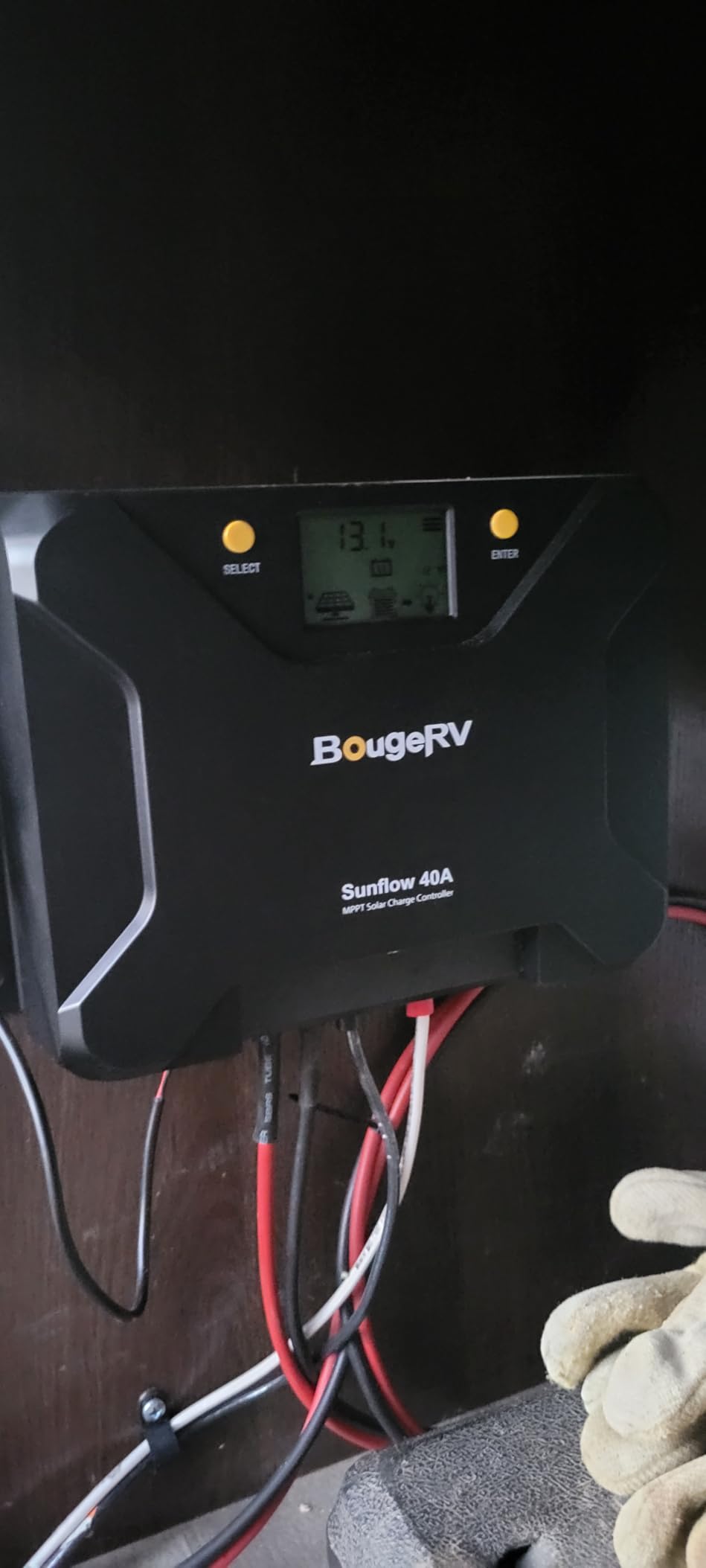
The BougeRV 40A MPPT is the controller we would fit in a camper van in January. The headline feature for cold-weather use is the LiFePO4 low-temperature charging cut-off below 32F, paired with a restart function that revives dormant 12V and 24V batteries. That combination is the reason lithium owners in cold climates like it, because many batteries cut themselves out below freezing and need a controller willing to bring them back.
Capacity is generous. Maximum PV input power is 600W at 12V and 1200W at 24V, with a 95V maximum PV voltage, and the charge current is adjustable from 0 to 40 amps. Tracking efficiency reaches 99.5% and peak conversion efficiency 99% on an aluminum heat sink with a dual MOS circuit to prevent reverse current.
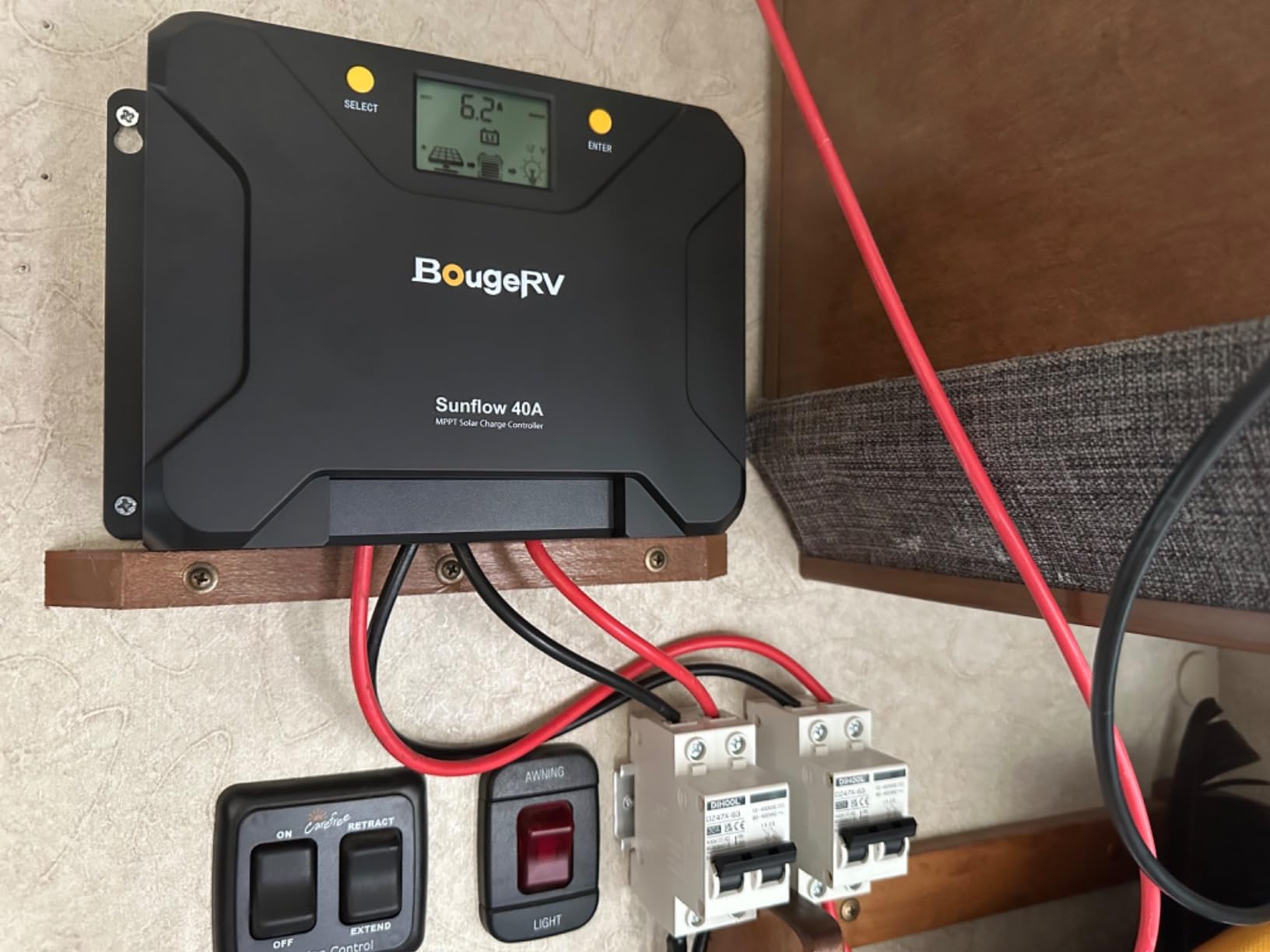
Build details are where this one earns its rating. The large screw terminals accept a real screwdriver, which sounds trivial until you have fought a 2 mm recessed screw in a van at dusk, and supplied spades fit solar wire properly. It is CE and RoHS certified with six built-in protections covering over-temperature, open circuit, short circuit, overload, reverse polarity, and reverse current.
Owners report an easy 15-minute installation with clear instructions and immediate results, plus useful data metrics in the app covering panel, battery, and load status. Rated load current is 20A and the wiring spec covers 15 through 8 AWG, so a small lighting circuit can hang off the load terminal.
How does the cold-weather cut-off actually help?
Charging a lithium battery below freezing plates the cells internally, and doing it repeatedly causes permanent capacity loss. Most quality lithium batteries refuse to charge when they get cold, which is correct behaviour but leaves you with no charge on a frosty morning. This controller enforces the cutoff itself, so you are not relying on the battery’s own BMS, and the restart function recovers a bank that has already been shut down.
That makes it a good match for RV owners who store a van outdoors or spend winters in cold climates. It also means you can pair it with a cheaper lithium pack that lacks a built-in low-temperature function, since the controller is handling that job.
What about the app and the warranty?
The app is the weak point, and it is a specific weakness: it requires an online account login, so in an area with no cell coverage it simply will not connect, and Bluetooth range is short, often failing beyond about ten feet. The installation and setup instructions are also poorly written enough that users resort to third-party videos, and the lug insertion slot is very small, so terminals should be test-fitted before crimping.
Support is an 18-month manufacturer warranty with 18 months of technical support, which is shorter than the three years on the Renogy Rover. Some controllers have returned error codes and refused to charge at all. If you can live with the app and want the cold-weather lithium handling, this is still a strong pick; if warranty length is decisive, the Renogy or the HQST both carry longer cover.
10. LiTime 12V/24V 30A MPPT Controller with Built-In Bluetooth – Best for Load Switching
LiTime 12V/24V 30A MPPT Solar Charge Controller Bluetooth, LCD Display
30A MPPT, 12V/24V
Built-in Bluetooth
LiFePO4 mode
Copper wire connectors included
Pros
- Solid die-cast build with an easy-to-read display
- MPPT charging performs well including with LiFePO4 packs
- Built-in Bluetooth with no extra dongle
- Load terminals let the load be monitored and switched from the app or a button
- Two-year warranty
Cons
- App forgets its Bluetooth pairing after shutdown and re-prompts repeatedly
- Larger housing than a typical 30A controller
- Buttons feel cheap
- Bluetooth only works at close range
The LiTime 30A stands out for one reason: the load terminals. Most controllers in this roundup either have no load output at all or only use it as a low-voltage disconnect. This one lets you monitor the load and switch it from the app or from a button on the case, which turns the controller into a small power management hub for a camper or a portable station.
Bluetooth is built into the unit, not sold as an accessory, and the free companion app shows detailed system statistics. That combination puts it in the same convenience tier as the Victron and the HQST, and users describe it as pairing cleanly with LiTime batteries.
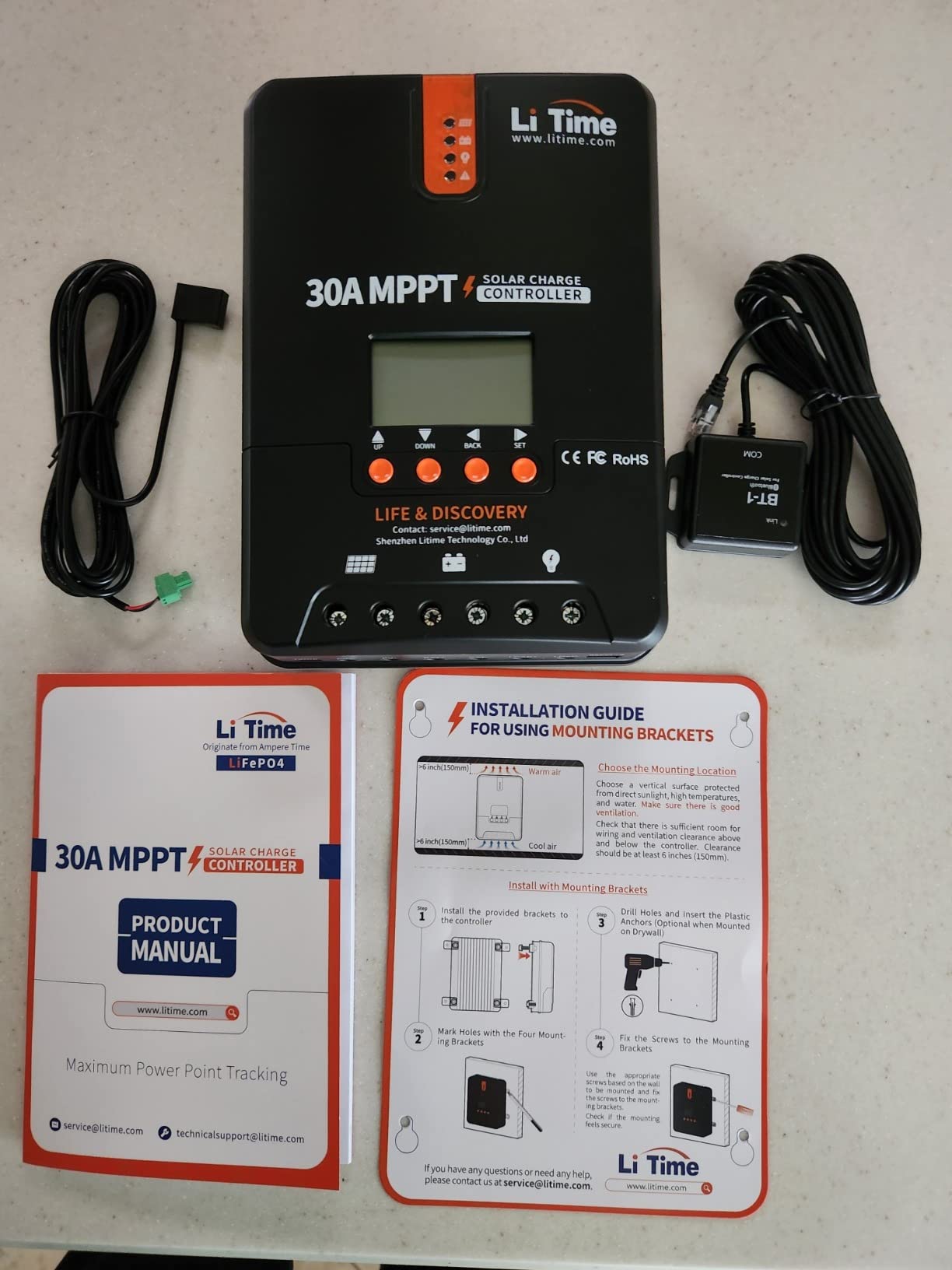
Construction is die-cast aluminum for heat dissipation, weighing 4.4 pounds across a 9.65 by 3.25 by 7.09 inch body. The front panel carries an LCD with four menu buttons plus multiple LED indicators for array, battery, load, and controller state, and copper wire connectors are included in the box to increase contact area on the terminals.
Charging performance is rated at not less than 99% tracking efficiency and up to 98% peak conversion efficiency. Protections cover reverse connection, overpower, overvoltage, short circuit, and over-temperature, and there is a dedicated LiFePO4 charging mode alongside sealed and gel lead-acid support through parameter adjustment.
Is the load output worth building around?
It depends on what you attach. If you run lighting, a pump, or a small appliance off the load terminal, being able to see its draw and cut it from your phone is a real convenience, and it also means the controller can protect the bank at a configured cutoff rather than leaving loads to drain it. For a system that only charges a battery and nothing else, you will not use it.
Warranty is two years, which sits between the one-year coverage on some budget controllers and the three years on the Renogy Rover, and the product is covered by AIG product liability insurance.
Where it falls behind the Victron and the HQST
The app is the main gap. Users report it forgets its Bluetooth pairing after shutdown and re-prompts repeatedly, some screens use dark gray on black and are hard to read in bright conditions, and the interface contains awkward translation artifacts. Bluetooth also only works at close range, and the four buttons feel cheap and require precise pressing.
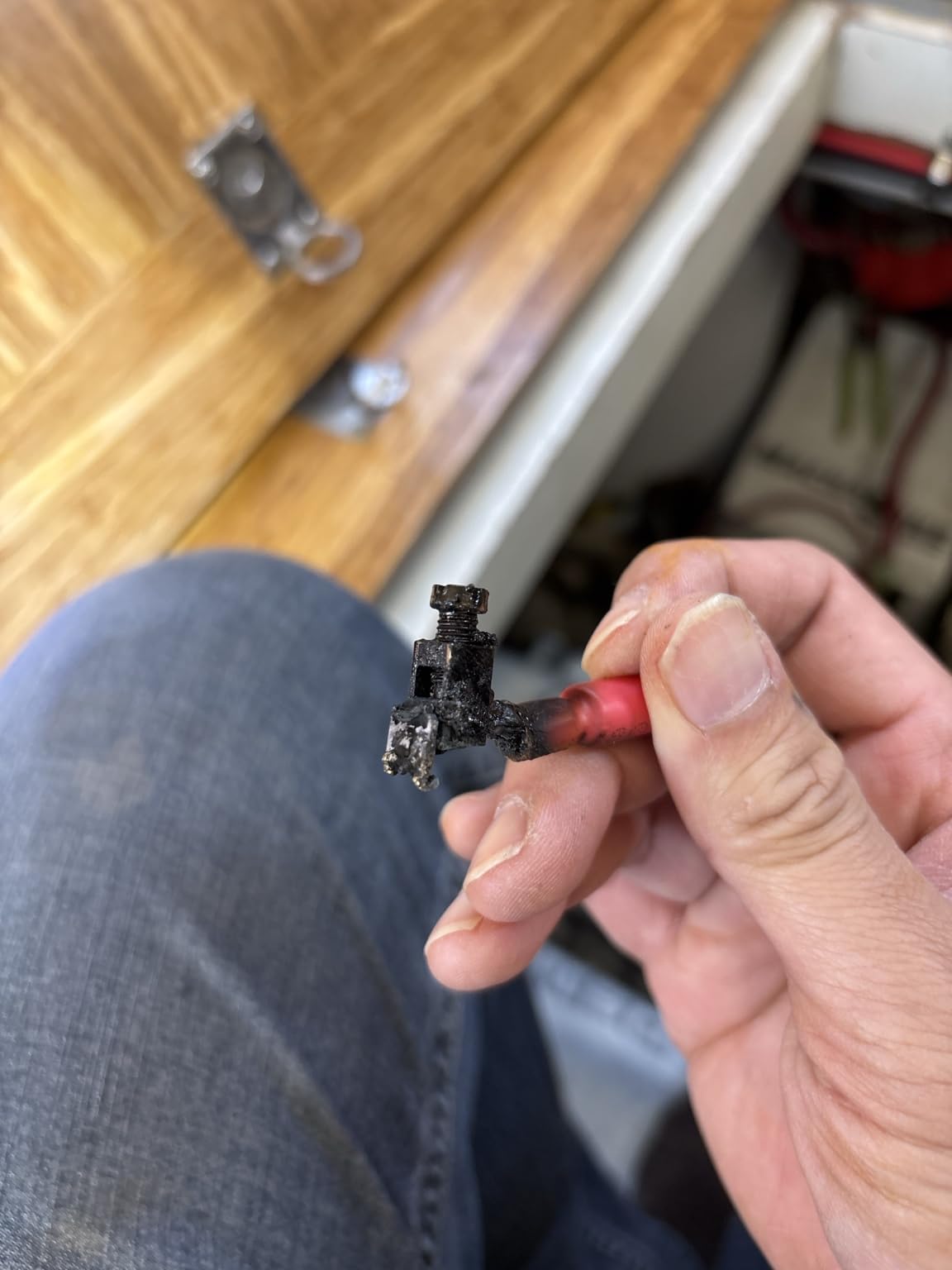
Size is a consideration too, since the housing is larger than a typical 30A controller and needs more panel space. One of two controllers a buyer purchased went completely dead after about eight months, an isolated report rather than a pattern, but it is the kind of thing to weigh if the controller is hard to reach for a swap.
How to Size a Solar Charge Controller (with a 400W Worked Example)
Sizing is arithmetic, and it takes about thirty seconds once you have the formula. Take your array’s total wattage, divide by your battery bank voltage, then divide again by an efficiency factor of 0.85 to account for conversion losses and the headroom a controller needs to run cleanly. Round the result up to the next standard amperage rating.
For a 400W panel on a 12V battery, that is 400 divided by 12, which is 33.3 amps, and 33.3 divided by 0.85 is roughly 39 amps. Round up and you need a 40 amp controller, which is exactly why the Renogy Rover 40A matches a 400W panel so cleanly. The same 400W array on a 24V bank needs 400 divided by 24, or 16.7 amps, and after the efficiency factor about 19.6 amps, so a 20A controller is enough.
Once you have the number, the second check is voltage. Divide the array wattage by its current operating point to get array voltage, and confirm it stays under the controller’s maximum PV input. In practice the calculation is simpler than that: 400W on a 12V system is normally a 30V nominal panel, and a 30V nominal panel is well under a 100V ceiling, so you have plenty of headroom. Series strings are the case to watch, because temperatures near -10F can push panel VOC roughly 20 to 25 percent above its 25C rating, and a cold-morning overvoltage is a genuine failure mode.
You also need to sanity-check the battery side. Charging current should stay comfortably below the battery bank’s capacity in amp-hours, generally no more than about 10 to 50 percent depending on the chemistry and the manufacturer’s guidance, and a bank that is too small will absorb a large controller current as heat rather than storing it.
Finally, match your answer to the model list. A 20A to 30A answer points you at the Renogy Wanderer Li, the BougeRV Li, the EPEVER Tracer, or the LiTime. A 40A answer points at the Renogy Rover or the BougeRV 40A MPPT. A 100A answer points at the HQST, and a large series string points at the HQST as well because of its 150V PV input ceiling.
How to Choose the Right Solar Charge Controller
Most buyers get the amperage right and then pick on features that turn out not to matter. Here is the decision order that produced this list.
1. Match the charge current to your array and your battery
Use the sizing formula above first, because it eliminates half the catalogue instantly. Then check that your battery bank can accept the current you have chosen. A 100 amp controller feeding a small flooded battery bank will shorten that bank’s life regardless of how good the controller is.
2. Check PV input voltage before you buy anything
Maximum PV input voltage decides whether you can series panels, and series panels is how you reduce cable size on a larger array. Anything above 100V gives you room for three or more panels in series. Remember to check the cold-morning VOC, not just the nameplate voltage.
3. Confirm the battery chemistry, especially for lithium
LiFePO4 wants a bulk-absorb-float profile with no equalization, and many controllers need that selected explicitly or tuned by hand. The HQST in this list ships with conservative lithium defaults that throttle output until you raise them, and several PWM units here are lead-acid only. A controller with a dedicated lithium profile and a low-temperature cut-off is the right target for a van or boat.
4. Decide how much monitoring you actually want
Built-in Bluetooth is increasingly common and saves you an accessory purchase that owners repeatedly describe as a hidden cost. The Victron, the HQST, and the LiTime have it in the box. The Renogy Rover needs a BT-2 module, the Wanderer Li needs a BT-1, and the EPEVER uses RS485 with a separate meter or adapter. If you will not open the app, buy the remote meter and skip the dongle.
5. Check grounding, load output, and warranty before ordering
Negative grounding or common negative is the correct convention for RV and marine installs, where chassis and panel frames can tie the two sides together. A load output terminal matters if you want the controller to protect the bank by disconnecting small loads. Warranty length ranges from one to three years across this list, and forum users treat US-based support and warranty serviceability as a decisive factor, often more decisive than a specification difference.
6. Check the terminals, not just the amperage
Terminal size determines whether your installation is safe. Several controllers here barely accept 10 AWG wire despite a 30A or 100A rating, which means a good crimp is impossible and the connection will run hot. If your battery cable will be 4 AWG or heavier, only a few models in this list are appropriate, and the EPEVER Tracer is explicitly noted for accepting 4 AWG cable.
7. Look at the warranty and support, and the rebrand question
Warranty here runs from 12 months on the budget models to three years on the Renogy Rover, with 18 months on both BougeRV controllers and two years on the LiTime. Support quality is the axis forum users rank highest after voltage accuracy, and dealer-only support structures are a common complaint about premium brands in the US.
It is also worth knowing when two different brand names are the same hardware. Several brands sell controllers built on the EPEVER TracerAN platform, which is why a SolarEpic-labelled unit and an EPEVER-labelled unit can be functionally identical with different manuals and support lines. Buying the one with the better local support and documentation is often the smarter move, even when the badge is unfamiliar.
8. Plan for maintenance and the float-stage problem
If your controller uses fans, expect to clean them. Dust loading in RV and boat installations is a real complaint, and a fan that gets loud is usually a fan that is full of dust. Keep clearance around the heat sink, and check terminal torque periodically, particularly on high-current models where a loosening connection generates heat.
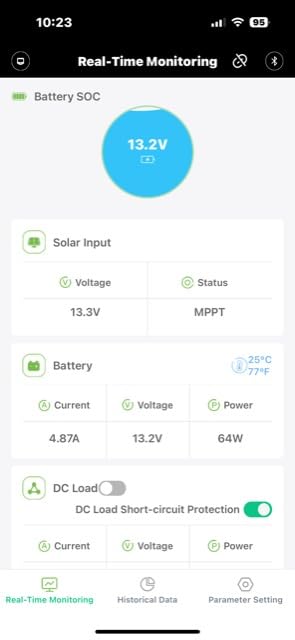
The most common real-user complaint across forums is float-stage creep, where a controller enters float in full sun while the battery is still well below full, usually because the reported battery voltage reads higher than the real thing. Several brands have been criticised for this, and one Reddit user running four premium controllers found every one overstated battery voltage. The diagnostic is simple: put a multimeter on the battery terminals while the controller reads its display. If they disagree by more than a tenth of a volt, your controller is running the charge profile off a biased measurement, and you should either correct the sense-wire connection or move to a controller with a more accurate sense input.
Frequently Asked Questions
Which brand of solar charge controller is considered the best?
It depends on the tier and the install. For a general-purpose 40A MPPT with a US support line and a three-year warranty, the Renogy Rover 40A is the strongest all-round choice. For a premium unit with an all-metal case, built-in Bluetooth and multi-controller sync, the Victron SmartSolar 100/50 leads on build quality and holds the highest rating in our roundup. For value, the EPEVER Tracer 30A delivers MPPT efficiency and large 4 AWG terminals at a fraction of the premium.
What are the disadvantages of using a solar charge controller?
The disadvantages are cost, added complexity, and installation effort. You are buying another box to mount and wire, another failure point in the system, and often another accessory like a Bluetooth dongle or a remote meter. You also have to set the battery type and charge parameters correctly, and a wrong setting can undercharge or overcharge a battery. Some cheap units also report battery voltage inaccurately, which pushes the controller into float too early and leaves the battery undercharged.
Do you really need a solar charge controller?
Yes, if you have panels feeding a battery bank of any meaningful size. Without a controller, a lead-acid battery will boil dry and a lithium pack will be overcharged, and at night the battery will drain backwards through the panels. The only exceptions are very small panel-and-cell combinations where the battery chemistry tolerates float charging indefinitely, which is not a configuration worth building.
What size MPPT controller do I need for a 400W solar panel?
Divide panel watts by battery voltage, then divide by 0.85 for losses. For 400W on a 12V bank that is 400 divided by 12, which is 33.3 amps, and 33.3 divided by 0.85 is about 39 amps, so a 40A controller is the right size. On a 24V bank, 400 divided by 24 is 16.7 amps and roughly 20A after the efficiency factor.
Do MPPT charge controllers work with LiFePO4 batteries?
They do, but only if the controller has a lithium profile. Most MPPT controllers here support LiFePO4 through a battery type selector or a user-defined lithium menu, and the better ones add a low-temperature charging cut-off below 32F plus a restart function for dormant packs. Two controllers in this roundup are lead-acid only, and one ships with conservative lithium defaults that need manual adjustment before they will pass full panel current.
Final Verdict: Which Solar Charge Controller Should You Buy?
For most people reading this, the answer is the Renogy Rover 40A MPPT. It has the strongest combination of rating, review volume, feature completeness, and warranty length in the group, and it covers the most common array size without a learning curve. Pick the Victron SmartSolar 100/50 if the enclosure, the all-metal construction, and built-in Bluetooth justify the premium for a boat or a remote cabin. Pick the EPEVER Tracer 30A if you want MPPT efficiency, temperature compensation, and 4 AWG terminals. Pick the HQST 100A if you are stringing panels in series or running a 48V bank.
Whichever one you choose, size it with the formula above, set the battery type before you close the cover, and check the reported battery voltage against a multimeter on day one. That last habit catches most of the problems owners complain about in the forums, and it takes about two minutes. If you are still choosing panels and batteries to go with your controller, start with our RV solar panel kit guide to put the whole system together properly.